差不多 (chàbuduō) as a Predicate

As a predicate, 差不多 can be used pretty much all by itself to complete a sentence after you tell us what subject we’re talking about. When several things are 差不多 (chàbuduō), it means they are “more or less the same.” So actually 差不多 (chàbuduō) is often understood to mean 差不多一样 (chàbuduō yīyàng), but you don’t say the 一样 (yīyàng) part. You just say 差不多 (chàbuduō).

Simple Subject

Let’s first assume that the subject is an easily understood group of people or things.

Structure

Subj. + 差不多

You might also add a  (dōu) in before 差不多 (chàbuduō) if there are more than two things being compared.

Examples

  • 这 几 个 地方 都差不多。
  • Zhè jǐ gè dìfang dōu chàbuduō.
  • These places are all pretty much the same.
  • 这 两 个 词 的 意思差不多。
  • Zhè liǎng gè cí de yìsi chàbuduō.
  • The meanings of these two words are pretty much the same.
  • 我们 的 想法差不多。
  • Wǒmen de xiǎngfǎ chàbuduō.
  • Our ways of thinking are pretty much the same.
  • 那 两 家 餐厅 的 菜差不多。
  • Nà liǎng jiā cāntīng de cài chàbuduō.
  • Those two restaurants’ dishes are almost the same.
  • 你们 的 中文 水平差不多。
  • Nǐmen de Zhōngwén shuǐpíng chàbuduō.
  • Your Chinese levels are almost the same.

Several Subjects

Let’s add in a few different subjects now, using the Chinese word for “and.”

Structure

Another often used structure is:

A + 跟 / 和 + B + 差不多

Examples

  • 上海和 纽约 差不多。
  • Shànghǎi héNiǔyuē chàbuduō.
  • Shanghai and New York are basically the same.
  • Starbucks 和Costa 差不多。Starbucks hé Costa chàbuduō.
  • Starbucks and Costa are almost the same.
  • 这里 的 天气跟 台湾 的 天气 差不多。
  • Zhèlǐ de tiānqì gēnTáiwān de tiānqì chàbuduō.
  • The weather here is pretty much like Taiwan’s.
  • 你的 工作跟 我的 工作 差不多。
  • Nǐ de gōngzuò gēnwǒ de gōngzuò chàbuduō.
  • Your job and my job are almost the same.
  • 你的 新 手机跟 我的 旧 手机 差不多。
  • Nǐ de xīn shǒujī gēnwǒ de jiù shǒujī chàbuduō.
  • Your new cell phone is pretty much like my old cell phone.

差不多 (chàbuduō) as an Adverb

When using 差不多 (chàbuduō) as an adverb, place it before the adjective or verb.

Structure

差不多 + Adj. / Verb

Examples

  • 这 两 个 孩子差不多 大。
  • Zhè liǎng gè háizi chàbuduōdà.
  • These two children are more or less the same age.
  • 我跟 我哥哥 差不多 高。
  • Wǒ gēnwǒ gēge chàbuduō gāo.
  • My older brother and I are more or less the same height.
  • 我差不多 到 公园 门口 了。
  • Wǒ chàbuduōdào gōngyuán ménkǒu le.
  • I’m almost at the entrance of the park.
  • 电影差不多 要 开始 了。
  • Diànyǐng chàbuduōyào kāishǐ le.
  • The movie is almost about to start.
  • 今天 的 工作差不多 做 完 了。
  • Jīntiān de gōngzuò chàbuduōzuò wán le.
  • Today’s work is almost done.

差不多 (chàbuduō) with a Quantity or Time Phrase

After 差不多 (chàbuduō) you can also add a phrase that expresses quantity or time. This makes it clear that you’re giving a rough estimate.

Structure

差不多 + [Quantity Phrase] / [Time Phrase]

Examples

  • 你 儿子差不多 五 岁 了 吧?
  • Nǐ érzi chàbuduōwǔ suì le ba?
  • Your son should be about 5 years old, right?
  • 他 住 在 上海差不多 三 个 月 了。
  • Tā zhù zài Shànghǎi chàbuduōsān gè yuè le.
  • He has lived in Shanghai for about three months.
  • 我 在 这 家 公司 工作 了差不多 十 年 了。
  • Wǒ zài zhè jiā gōngsī gōngzuò le chàbuduōshí nián le.
  • I’ve worked for this company for almost ten years.
  • 我 父母 结婚差不多 二十 年 了。
  • Wǒ fùmǔ jiéhūn chàbuduōèrshí nián le.
  • My parents have been married for about twenty years.
  • 差不多两 个 星期 以前,我 在 北京 见 过 他。
  • Chàbuduō liǎng gè xīngqí yǐqián, wǒ zài Běijīng jiàn guo tā.
  • About two weeks ago I met with him in Beijing.


Welcome to have my face to face lesson on http://www.verbling.com/teachers/dawei  !  🙂


Common Sentence Structures in Mandarin Chinese

This article presents some of the most commonly used sentence patterns in Mandarin Chinese. Examples of how to use each sentence structure will be given, and pinyin as well as English translations will be provided.

  • What is Learned in This Lesson?

Every language has structures and patterns for forming sentences. Mandarin Chinese is just the same. Needless to say, it is very important to learn the most commonly used Mandarin Chinese sentence patterns. This will help students form complete sentences and make it easier for Chinese language learners, or CSL language learners, to begin to speak fluently and express their opinions, thoughts and daily happenings accurately. Many students know many Chinese words, but lack the ability to use such Mandarin vocabulary fluently in speaking or writing Chinese; understanding how to use common Mandarin sentence structures is a great way to polish up your Chinese and make better use of your Chinese vocabulary.

  • 越来越 (yuè lái yuè)

越来越 means “more and more.” This phrase is very useful. Typically an adjective is placed after the phrase in order to describe what is becoming more and more or what is becoming better. Here are a few example sentences:

你的中文越来越好。(Nǐ de zhōngwén yuè lái yuè hǎo) = Your Chinese is getting better and better.

你的女儿越来越漂亮。(Nǐ de nǚ’ér yuè lái yuè piàoliang) = Your daughter is getter more and more beautiful.

  • A ..(bǐ)

比 () is the character that is used for comparisons in Mandarin Chinese. For those who have yet to learn how to make comparisons in Chinese, this is the most useful character to learn. Used in a sentence, its structure is pretty simple; the structure goes as follows: A 比 B and then an adjective. Have a look at a couple of examples:

今天的天气比昨天的天气热。(Jīntiān de tiānqì bǐ zuótiān de tiānqì rè.) = The weather today is hotter than the weather yesterday.

他的篮球打得比我好。(Tā de lánqiú dǎ dé bǐ wǒ hǎo.) = He plays basketball better than me.

  • 虽然。。。但是 (suīrán…dànshì)

虽然 means “although” or “though” and 但是 means “but” or “however.” This 但是 is placed here for emphasis. Check out a few example usages to get the hang of this commonly used Chinese sentence structure:

虽然老师很严格,但是他心底不坏。(Suīrán lǎoshī hěn yángé, dànshì tā xīndǐ bù huài.) = Although the teacher is very strict, he is good person at heart.

虽然外面在下雨,但是我还是想去打高尔夫球。(Suīrán wàimiàn zàixià yǔ, dànshì wǒ háishì xiǎng qù dǎ gāo’ěrfū qiú.) = Although it was raining outside, I still wanted to play golf.

  • 当。。。的时候 (dāng… de shíhòu)

When you say “when” in Chinese, you must use the enclosed structure of “当。。。的时候.” 当 means “to be” or “to be equal to” in this sense and 的时候 means “time” or “when” in this sense. In spoken Chinese, the 当 is not necessary but it is always good to add for clarity. Notice that the time expression of 时候 comes after the topic of the sentence.

当他来的时候,外面在下雨。(Dāng tā lái de shíhòu, wàimiàn zàixià yǔ.) = When he came, it was raining outside.

  • ….以后 (yǐhòu)

以后 means “after” or “afterwards” in Chinese and is usually placed after the event. For example, Chinese word order goes as follows: We go to the movies after, we can eat. Have a look:

下过雨以后,空气很干净。(Xiàguò yǔ yǐhòu, kōngqì hěn gānjìng.) = After the rain, the air is very clean.

  • 不管 (bùguǎn… hái)

不管 means “regardless of” or “no matter…” and 还 means “still.” Although 还 is not always constructed with 不管, it is still often used together with it and it is good to remember this structure.

不管别人听不听,我还会说。(Bùguǎn biérén tīng bù tīng, wǒ hái huì shuō.) = Regardless of whether or not people are listening, I will still speak.

  • 不可 (fēi… bùkě)

This is one of the most commonly used double negative structures in Mandarin Chinese. It essentially means “must” or “absolutely must” or “need to.” 非 means “not” or “no” and 不可 “not able to”; hence it literally translates as “not not able to.” 非 is placed after the subject of the sentence and 不可 closes out the sentence.

我非批评她不可。(Wǒ fēi pīpíng tā bùkě.) = I absolutely must criticize her.

  • 为主 (yǐ… wéi zhǔ)

This structure best translates as “to be mainly focused on…” or “to mainly value…” This is important if you want to describe the things that are important to you or the things your life is currently concerned with.

他出行以自行车为主。 (Tā chūxíng yǐ zìxíngchē wéi zhǔ.) = He travels mainly by bike.


Welcome to have my face to face lesson on http://www.verbling.com/teachers/dawei  !  🙂

What You’ve Gotta Know About the Chinese Verb “是”

What could be simpler than the little verb “to be”?

A lot, as it turns out.

The good news is that the Chinese verb for “to be,” 是 (shì), isn’t irregular like it is in so many European languages.

(Oh, right, this is Chinese. There aren’t any irregular verbs at all. Just take a moment to bask in the glory of that before you move on.)

The bad news is that only a few of the concepts expressed by “be” in English are expressed with 是 (shì) in Chinese.

The really good news is that we’ll tell you exactly which expressions they are, and we’ll even tell you what to do about the ones that aren’t used with this tricky word. Not only that, but we’ll also give you helpful tips to practice using these super common expressions.

No big, abstract concepts here. Just simple, straightforward, useful Chinese.

To (shì) or Not to (shì): A Simple Guide to the Chinese Verb “to Be”

When to Use (shì)

First off, when does the verb “to be” stick around in Chinese?

  1. Use (shì) to connect two nouns

是 (shì) is used like the English verb “to be” when you want to connect two nouns (or pronouns) together in a sentence to explain what something, or someone, is:

我是美国人。(wǒ shì měi guó rén – I am an American.) Literally: American person

Just like English, right?

Make it your own:

Make sure you know how to tell people where you’re from by putting the name of your country into the blank:

我是 __ 人。 (wǒ shì ___ rén. – I am a(n) _____ person.)

Also, make sure you can tell people what you do, by substituting your job for 老师 (lǎoshī):

我是一个老师。(wǒ shì yí gè lǎo shī. – I am a teacher.)

This is also a great way to use simple sentences to practice vocabulary. Look around your house or work with a language partner and name the things you see.

这是手机。(zhè shì shǒu jī. – This is a cell phone.)

那是沙发。(nà shì shā fā. – That is a sofa.)

Or, if you’re not an absolute beginner, kick things up a notch and talk about what kind of things the things you see are. We’ll illustrate with an example:

苹果是一种水果。(píng guǒ shì yī zhǒng shuǐ guǒ. – Apples are a kind offruit.)

  1. Use (shì) in the phrase 是不是 (shì bú shì) to ask a question or confirm information

The phrase 是不是 (shì bú shì) is one way of asking a question in Chinese. If you want to make a question out of a sentence that has 是 (shì) as its verb, you can do it by substituting 是 (shì) with 是不是 (shì bú shì) “be not be.”

这是不是手机?(zhè shì bú shì shǒu jī. – Is this a cell phone?)

那是不是沙发?(nà shì bú shì shā fā. – Is that a sofa?)

苹果是不是一种水果?(píng guǒ shì bú shì yī zhǒng shuǐ guǒ? – Areapples a kind of fruit.)

However, the phrase 是不是 (shì bú shì) can also be added on to the end of a sentence to confirm something you think is true. For example, if you’re pretty sure someone is from Taiwan, you can confirm by asking:

你是台湾人,是不是?(nǐ shì Táiwān rén, shì bú shì. – You’re Taiwanese, aren’t you?)

You can confirm any type of information this way; it isn’t limited to sentences that already contain 是 (shì) as their main verb. So if you call someone up at dinnertime, you could ask her:

你在吃饭,是不是?(Nǐ zài chī fàn, shì bú shì. – You’re eating, aren’t you?)

The correct way to answer any of these questions is either 是 (shì), if the answer is “yes,” or 不是 (bú shì), if the answer is “no.”

Make it yours:

These are great sentences to practice with a language partner or a classmate. Take turns asking and answering. Granted, it may not be the most exciting conversation you’ll ever have, but still, you’ll be having a real conversation in Chinese.

A: 这是不是手机?(zhè shì bú shì shǒu jī? – Is this a cell phone?)

B: 。那是不是沙发?(shì nà shì bú shì shā fā? – Yes. Is that a sofa?)

A: 不是。(bú shì – No.)

While these are grammar points that every beginning Chinese student will become familiar with, 是 (shì) shows up many other places in Chinese, too. Up next are a few simple phrases you can use to get yourself started with real Chinese conversations.

  1. Use (shì) to keep a conversation going with the phrase “是吗? “(shì ma)

If you’re tired of trying to string together Chinese sentences and want to keep the other person talking, throwing in a 是吗? (shì ma) here and there’s a good way to do it. It’s the Chinese equivalent of something like “Oh, really?” or “Yeah?”

As long as you don’t make yourself sound exceedingly skeptical, the other person will take it as a sign that you’re interested in what they’re saying and keep on going.

Make it yours:

Next time someone starts telling you a story in Chinese, try responding with 是吗? (shì ma) when they pause. As long as the other person keeps talking, you don’t have to.

  1. Use (shì) to agree in conversation

Another good way to show you’re following a conversation is to occasionally agree with the person you’re listening to. To do that, try using these 是 (shì) phrases:

  • 是的(shì de) is for mild agreement. It’s the equivalent of “uh-huh” or “yeah.” This mostly serves to show the speaker that you’re listening, you’re empathizing with them or you want to hear more.
  • 是啊(shì a) is a bit stronger. Now you’re not just being polite—you agree with what you’re hearing and you feel a bit excited about it. If you want to make sure the speaker knows how you feel, you can interject a 是啊 (shì a) a during a pause. This is like saying “Right!”
  • 就是(jiù shì) is the most emphatic of the three. There’s no doubt in your mind that the speaker is correct and you want to express your firm agreement. Think about the English phrases “Of course!” or “I know!”

Make it yours:

Just like 是吗? (shì ma), these phrases help to transform you into an active conversation partner. Even if you can’t think of anything else to contribute, these phrases will ensure that you’re not at a complete loss for words. Again, try these out in place of the smile and nod you usually use when someone launches out with a long narrative in Chinese.

When to not Use  (shì)

By now it should be clear that the verb 是 (shì) is really common in Chinese. But it still isn’t nearly as common as the verb “to be” is in English. There are at least four common ways in which English speakers use “be” that 是 (shì) just can’t be used in Chinese.

  1. Do not use (shì) to connect a noun and an adjective

In English, we say “The child is tall” or “The toy is soft.” Chinese people do not say “孩子是高” (hái zi shì gāo) or “玩具是软” (wán jù shì ruǎn) to communicate these ideas.

Instead, use (hěn)

Chinese sentences of this sort don’t require a verb. Instead, they typically include an intensifying adverb such as很 (hěn) “very” between the subject and the adjective.

孩子很高 (hái zi hěn gāo. – The child is tall.)

玩具很软 (wán jù hěn ruǎn. – The toy is soft.)

  1. Do not use (shì) to connect a noun and a prepositional phrase

In English we say “My friend is in the library” or “The cat is on the table.” Not so in Chinese.

Instead, use (zài).

 (zài) is a preposition meaning “at”—but in sentences like these, it takes the same place that the verb “be” does in the English ones. After that you have the location. Then, if “at” doesn’t describe your location well enough, you can end your location phrase with a second preposition (postposition, if you want to be technical about it).

Got that? It’s Subject + (zài) + Location (+ Preposition)

我的朋友在图书馆 (wǒ de péng yǒu zài tú shū guǎn. – My friend is at the library.)

我的朋友在图书馆里 (wǒ de péng yǒu zài tú shū guǎn lǐ. – My friend is in the library.)

猫在桌子上 (māo zài zhuō zi shàng. – The cat is on the table.)

  1. Do not use (shì) to say “there is/there are”

In English, we use “to be” when talking about the existence or presence of an object: “There’s a cat on the table,” “there are ants in the kitchen.” In Chinese? Not so much.

Instead, use (yǒu).

Chinese takes yet another strategy here: It uses the verb  (yǒu), meaning “to have.” 有 (yǒu) goes at the beginning of the sentence. No subject is necessary. Then follow the same word order we just learned for location sentences.

有猫在桌子上 (yǒu māo zài zhuō zi shàng. – There’s a cat on the table.)

有蚂蚁在厨房里 (yǒu mǎyǐ zài chú fáng lǐ.  – There are ants in the kitchen.)

  1. Do not use (shì) as a helping verb

Finally, English speakers use the verb “be” as part of the present or past continuous verb tenses: “I am eating an apple,” “He is running.”

As you’ve probably guessed by now, Chinese speakers don’t.

Instead, use (zài).

Chinese speakers use  (zài) when they want to emphasize the continuous nature of the event they’re talking about.

And yes, this is the same 在 (zài) we were just talking about. It even takes the same position in the sentence that “be” does in English. So in Chinese, you’ve got Subject + (zài) + Verb (+ Object).

我在吃苹果 (wǒ zài chī píng guǒ. – I am eating an apple.)

他在跑步 (tā zài pǎo bù. – He is running.)

FAQ: You Really Can’t Use (shì) to Connect a Noun and an Adjective?

Ah, you’ve been paying attention, haven’t you? You’re pretty sure you heard someone use 是 (shì) followed by an adjective. First, congratulations on your excellent listening skills!

Second, there are in fact quite a few places that an adjective might follow 是 (shì) in Chinese, but they aren’t the equivalent of simple sentences of the sort “The leaves are green” or “The man is fat.”

We won’t go into these in detail here, but if you’re curious, we’ll give you some links to explore on your own.

The (shì-de) construction

The first of these is what’s often called the 是-的 (shì-de) construction. This is used to put emphasis on whatever words show up between the 是 (shì) and the 的 (de). You might hear it in a sentence like the following:

树叶是绿色的。(shū yè shì lǜsè de. – The leaves are green.)

Note the 的 (de) at the end of the sentence. This sentence is likely the answer to a question about what color the leaves are.

老是 (lǎoshì) or 总是 (zǒngshì)

A second place you’ll hear 是 (shì) followed by an adjective is when 是 (shì) is actually part of the word, like 老是 (lǎoshì) or 总是 (zǒngshì), both of which mean “always.”

So you might hear someone say “她总是很高兴” (tā zǒng shì hěn gāo xìng)“She’s always happy.” But this isn’t the same as using 是 (shì) to connect a noun and an adjective. Here, 是 (shì) isn’t acting as a verb.

For more information on how to use these, see the entries on 老是 (lǎo shì) and 总是 (zǒng shì).

Oh, and the post title?

It’s catchy, but it turns out that Chinese also fails to use the verb “be” when pondering questions of continued existence à la Shakespeare. This gets translated

生存还是毁灭,这是个问题 (Shēng cún hái shì huǐ miè, zhè shì gè wèn tí) (To survive or to perish, that is the question.)

We’ll leave that one for Hamlet to ponder.

Welcome to have my face to face lesson on http://www.verbling.com/teachers/dawei  !  🙂

The “however” adverb “却”

却 (què) is used to indicate something was contrary to expectations, and is used in a similar way to . However, it is generally followed by a negative comment:

Structure

The overall structure of sentences that use 却 is something like this:

Sentence, Subj. + 却 + ⋯⋯

Normally the first clause above makes a statement, and then the second clause introduces something contrary, generally in the form of a negative comment.
It’s also important to point out that 却 is not a conjunction; it’s an adverb. Practically speaking, this means that rather than joining two statements, it goes inside a statement (within the second clause). Specifically, it needs to come after the subject and before the verb. (Note that when you use a conjunction like 但是 it comes before the subject! 却 is different in this respect. Also, rather than replacing 但是, it can work with it to add emphasis.

Also, sometimes the subject of the second clause will be omitted. If there is a subject, however, 却 definitely needs to come after it.

  • 我 等 了 她 很 长 时间 ,她 没 来 。
  • 我 等 了 她 很 长 时间 ,她 没 来 。
  • 有 些 人 博客里 的 文章 不 多 , 内容 不 错 。
  • 有 些 人 博客里 的 文章 不 多 , 但是 内容 不 错 。
  • 有 些 人 博客里 的 文章 不 多 , 内容 不 错 。
  • 有 些 人 博客里 的 文章 不 多 , 但是 内容 不 错 。

Examples

In the following examples, take note that 却 comes after the subject in each case, and that it can be used together with 但是.

  • 他 用 的 潜水 装备 都 很 专业,但是 他 的 水平却 很 低。His diving equipment is all specialized, but his level is quite low.
  • 虽然 是 自己 种 的 菜,不过 味道却 没有 超市 的 好。Although it’s home-grown veggies, it’s flavor just isn’t as good as the supermarket’s.
  • 他 只有 16 岁,想法却 比 20 几 岁 的 人 还 成熟。He’s only sixteen, but his perspectives are more mature than people in their twenties.


You & Me. This & That: Pronouns in Chinese

1

Personal Pronouns in Chinese 人称代词 (rén chēng dài cí)

2

One of the first words you probably need to learn is ‘I’  (wǒ). Although in Chinese, you can often get away with missing off the 我 (wǒ) ‘I’ in spoken Chinese, it is important to use it within written Chinese.

The word for ‘you’ is  (nǐ) and can also be used in its formal version  (nín), which is used to show respect to elders or superiors.

Do you know that in spoken Chinese, the words for he she and it are all the same? In a conversation with someone, it’s easy to ask the other person for clarification, but what happens in written Chinese? Luckily, personal pronouns in the written language of Mandarin Chinese have different characters.

 (tā) – he

 (tā) – she

 (tā) – it

If you know a little about radicals in Chinese, you might know that usually, the meaning of the character is on the left, and the pronunciation is on the right side. Both the characters for he and she have the same radical to suggest the way it is spoken.

The left side of the character for he 他 (tā) has the person radical  (rén), suggesting male origins. The character for ‘she’ 她 (tā), has the female radical  (nǚ) to the left of it, which indicates it is female.

Plurals

3

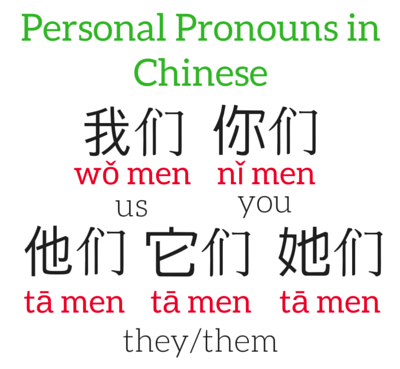
In order to pluralize personal pronouns in Chinese and create ‘we’, ‘us’ ‘they’ or ‘them’, you simply add  (men).

我们 (wǒ men) – us/we

你们 (nǐ men) – you (plural)

他们 (tā men) – they/them

她们 (tā men) – they/them

它们 (tā men) – they/them

他们去外面吃饭。(tā men qù wài mian chī fàn.) – They went out to eat.

Possessive  物主代词 (wù zhǔ dài cí)

Technically, the Chinese language does not have possessive pronouns, but it classed as a rule of the (de) particle.

To make a pronoun ‘possessive’, you add the 的 (de) particle. Although the 的 (de) particle has many uses, at the moment it is enough to know that it makes pronouns possessive.

我的 (wǒ de) – mine

你的/您的 (nǐ de/nín de) – yours

他的 (tā de) – his

她的 (tā de) – hers

If you want to say ‘my cup’, it would look like this:

我的杯子。(wǒ de bēi zi)

Me (s) cup.

In the case of alienable possession (if the object is close to the subject like a family member), the 的 (de) particle can be removed.

我妈。(wǒ mā) My mother.

Finally, to say ours, theirs or yours add the 的 (de) particle to the plural pronoun.

我们的 (wǒ men de) – ours

你们的 (nǐ men de) – yours

他们的 (tā men de) – theirs

她们的 (tā men de) – theirs

Reflexive Pronouns

4

To refer to the ‘self’ in Chinese, we add the bigram 自己 (zì jǐ) to a personal pronoun:

我自己 (wǒ zì jǐ) – myself

你自己 (nǐ zì jǐ) – yourself

他自己 (tā zì jǐ) – himself

她自己 (tā zì jǐ) – herself

我们自己 (wǒ men zì jǐ) – ourselves

请用一句话介绍你自己。(qǐng yòng yī jù huà jiè shào nǐ zì jǐ.) Please introduce yourself in one sentence.

Interrogative Pronouns 疑问代词 (yí wèn dài cí)

5

Interrogative pronouns are ‘question’ words that express an enquiry.

 (shéi) – Who

他是谁?(tā shì shéi) Who is he?

什么 (shén me) – What

这是什么? (zhè shì shén me) What is this?

哪个 (nǎ ge) – Which

这两个玩具,你喜欢哪一个?(zhè liǎng gè wán jù, nǐ xǐ huan nǎ yī gè)

Which of these two toys do you prefer?

为什么 (wèi shén me) – Why

这么晚了,为什么你还不回家?(zhè me wǎn le, wèi shén me nǐ hái bù huí jiā.)

It’s late. Why don’t you go home?

怎么 (zěn me) – How

这个问题怎么解决?(zhè ge wèn tí zěn me jiě jué)

How do we solve this problem?

什么时候 (shén me shí hou) – When

你什么时候来中国? (nǐ shén me shí hou lái zhōng guó.)

When will you come to China?

哪里 (nǎ lǐ) – Where

我忘记把钥匙放哪里了。(wǒ wàng jì bǎ yào shi fàng nǎ lǐ le)

I have forgotten where I put my keys.

 (jǐ) How much/How many

我们几点见面?(wǒ men jǐ diǎn jiàn miàn)

When shall we meet?

 (duō) – Many/Much

你花了多长时间写作业?(nǐ huā le duō cháng shí jiān xiě zuò yè.)

How much time did you spend on your homework?

Rules for Interrogative Pronouns

There are some rules regarding interrogative pronouns. Here are some examples of when to use these pronouns:

For people or things use: 谁 (shéi) – who, 什么  (shén me) – what, 哪 (nǎ) which

For place or location use: 哪儿 (nǎr) or 哪里 (nǎ lǐ)

For time use: 哪会儿 (nǎ huì er) or 多会儿 (duō huì er)

For status, actions, method or property use: 怎么 (zěn me) or 怎么样 (zěn me yàng)

For quantity use:  (duō), 多少 (duō shao) or  (jǐ).

Generally, the usage of 几 (jǐ), is almost the same as 多少 (duō shao), so they can replace each other. However, 多 (duō) can also be used to ask for levels or amounts such as 多长 (duō cháng) meaning ‘how long’ or 多大 (duō dà) meaning ‘how large’, whereas 几 (jǐ) can not be used in this way.

When interrogative pronouns are used in the way that relative pronouns are used in English, then there should be always be an adverb such as  (dōu) or  (yě). These characters are interchangeable as they have almost the same meaning. Sometimes they will be used with words such as 不管 (bù guǎn) or 无论 (wú lùn) to create emphasis.

If 都 (dōu) or 也 (yě) are removed from the sentences below, they no longer have the same meaning. The first example shows the sentence with 都 (dōu) or 也 (yě), the second shows it without.

谁也不知道他在哪儿了。(shéi yě bù zhī dao tā zài nǎr le) – No one knows where he is.

≠ 谁不知道他在哪儿。 Every knows where he is (don’t they?)


你什么都不懂。(nǐ  shén me dōu bù dǒng) – You know nothing.

≠ 你什么不懂。 You know everything (don’t you?)

不管怎么解释,他都不明白。(bù guǎn zěn me jiě shì, tā dōu bù míng bai.) – No matter how it has been explained, he is unable to understand.

Indefinite Pronouns

Since there are no clear cut way to translate English indefinite pronouns into their Chinese equivalents, the words we know in the English language such as ‘anything’ and ‘something’ etc are not indefinite pronouns in Chinese. In the English language, indefinite pronouns are words that include some-, any-, every- etc

Here are the some of the ways you can translate the English indefinite pronouns into Chinese:

任何事() / 任何东西 (rèn hé shì (qíng) / rèn hé dōng xi) – Anything

有些事() / 有些东西 (yǒu xiē shì (qíng) / yǒu xiē dōng xi) – Something

有人/某人 (yǒu rén/mǒu rén) – Someone

每(个)人/人人 (měi (gè) rén / rén rén – Everyone

任何人 (rèn hé rén) – Anyone

Demonstrative Pronouns 指示代词 (zhǐ shì dài cí)

6

This and That

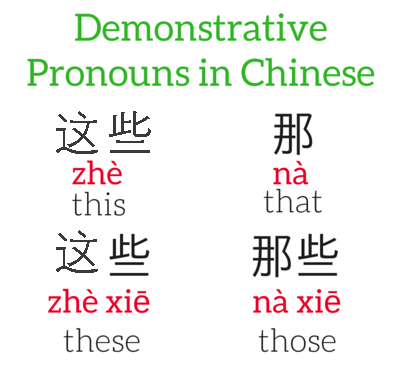
 (zhè) and  (nà) can be used as both demonstratives and specifiers. A demonstrative is used to ‘point out’ an item, so that it is not confused with another object. These two characters will be used as  (zhè) ‘this’ and   (nà) ‘that’.

这样 (zhè yàng) – like this/this way

这么 (zhè me) – this much

这会儿 (zhè huìr) – at this moment

那样 (nà yàng) – that kind

那么 (nà me) – like that

那会儿 (nà huìr) – never been seen

那是我的被子。(nà shi wǒ de bèi zi.) That is my quilt.

These and Those

This 这 (zhè) and that 那 (nà) can be turned into plurals by adding the character  (xiē), meaning ‘few’ or ‘several’. 这些 (zhè xiē) be used to say ‘these’ and 那些 (nà xiē) for ‘those’.

Here and There

这儿/这里 (zhèr / zhè lǐ) – Here

那儿/那里 (nàr / nà li) – There

There are several ways to pronounce here and there in Chinese. In the north of China, especially in Beijing, the first 这儿 (zhèr) and 那儿 (nàr) pronunciations are common. Whereas the 这里 (zhè lǐ) and 那里 (nà li) pronunciations are used in the south.

Sometimes 这儿 (zhèr) and 那儿 (nàr) are used at the beginning of a sentence as a subject and can be, but not necessarily followed by the preposition  (zài).

在这里有很多东西。(zài zhè lǐ yǒu hěn duō dōng xi.) There is a lot of stuff here.

If they are not the subject, then the 在 (zài) preposition must be used.

我在这里工作。(wǒ zài zhè lǐ gōng zuò) I work here.

Exercises

  1. How do you say ‘myself’ in Chinese?’
  2. The Chinese characters for this and that are 这 (zhè) and 那 (nà). Create mnumonics (a story or picture) to help you remember which one is which!
  3. Does the Chinese language have possessive pronouns? What is used to indicate a ‘possessive’ word?

If you’re interested in learning Chinese, welcome to have my face to face lesson on http://www.verbling.com/teachers/dawei  !  🙂


Personal pronouns in Chinese language – complete guide

Personal pronouns are the words that we use to substitute proper or common nouns. Such as I, you, she, he, his, her etc.

I strongly suggest you to get familiar with all personal pronouns in Chinese language before you dive deeper into mandarin Chinese lessons. First of all, personal pronouns will frequently appear in our dialog examples and reading practice in later lessons. Secondly, it’s must-to-have knowledge even for very basic conversations. Last, personal pronouns in Chinese language are very easy to grasp. Even simpler than those in English in my opinion.

You know what confuses Chinese students most when they start to learn English? – “Why there are so many variations in the usage of personal pronouns?!” To a Chinese student, “I” is “I”, no matter which position it appears in a sentence, it should stay as “I”! So now you understand there’s no change of forms for I, or you, or he, or she in a Chinese sentence at all. In fact, you only need to know 7 characters to be able to use ANY personal pronouns in Chinese language. They are:


men de

“我”needs 7 strokes to write it out. It’s not a very simple Chinese character, but is definitely among the highest frequency characters. Get a pen and paper now, and write the character on the paper for five times. You might not be able to remember how to write it tomorrow, but you have to be able to recognize it from now on (at least that’s my requirement for you to follow through the whole lesson series).

你, 他, 们, the three of them all have radical “亻” on their left hand side. “亻” implies “people related”. That doesn’t mean all people related characters have a “亻”. But there are a large amount of people related characters do. The right hand side part usually implies how the character sound. But not always either. We can give a name for this pattern so it’s easier for you to remember:

“meaning radical + sound part”

Among these three characters, only “们” perfectly fit into the “meaning radical + sound part” pattern:

“亻” (people related) + “门” [mén] (meaning: door)

As a matter of fact, there are big amount of Chinese characters follow the above rule. You will see more of them coming in the following lessons.

Now let’s get familiar with all the personal pronouns in Chinese language from the following tables:

Singularity: who

I you he
she it


Plurality: who + 们

we you they
我们 你们 他们


Possessive for singularity: who + 的

my your his
我的 你的 他的
her its
她的 它的


Possessive for Plurality: who + 们的

our your their
我们的 你们的 他们的


You might have noticed that “他” “她” and “它” all have exactly the same pronunciation. In Chinese, a few to a few tens of characters share the same pronunciation is quite common. That’s why in most cases you can’t tell Chinese people a single character and expect them to understand which character you’re referring to. You have to put the character in a word, or a sentence to make people understand exactly which character you’re talking about.

Please memorize the pronunciation and the look of all words. You’ll meet them frequently in the following lessons.

Welcome to have my face to face lesson on http://www.verbling.com/teachers/dawei  !  🙂
 

How to open your conversation with “Based on …”, “According to …” kind of patterns in Chinese

If you’ve followed our Learn Chinese online lesson series to this far, I believe you’ve known how to express your thoughts in a variety of ways in Chinese. Whether you are fluent in expressing them still depends on how large vocabulary you’ve grasped and how well you’ve progressed on your pronunciation. In my opinion, there’s no shorter path than practicing your language as much as you can.

The goal of this series of lessons is to help you build sentence patterns in your mind the “Chinese” way. With each sentence pattern you learned, you’re recommended to practice it with whatever you want to express. Try to simulate a conversation if you can’t find a real chance to chat in Chinese.

Keep your good work up, folks! OK, let’s get back on our topic today…

“Based on,”, “According to… “ … “As you know …” – these kinds of phrases are all quite often to be used to start a conversation, presentation, or a report, so on so force. We get into that today to learn how to start your conversation with these patterns.

Before anything else, let’s check out our new words first:

 jīyú  gēnjù  xūyào
基于 (based on) 根据(according to) 需要(needs)
zhèngrú  suǒ  jùshuō
正如 (just like) 所 (actually) 据说 (it is said that)
 mùqián  zhuàngkuàng  róngyì
目前 (current) 状况 (situation) 容易 (easy)
 yǒuhǎo
友好 (friendly)


Basically the following five phrases would fit your needs if you want to start your conversation from certain facts or known information. Let’s have a quick look at the Chinese translation of these phrases first:

“Based on …”  -> 基于 jī yú…

“According to …”  -> 根据 gēn jù …

“As we all know …”  -> 我们都知道 wǒmen dōu zhīdào …

“As you know …” -> 正如你所知 zhèngrú nǐ suǒzhī …

“It is said that …” -> 据说 jù shuō …

Then I’ll show you how to use them in the following examples. All of these five phrases can be used both in written and oral Chinese.


jīyú mùqián de zhuàngkuàng, huódòng bèi qǔxiāo le.

基于目前的状况活动被取消了.

Based on the current situation, the event has to be cancelled.


gēnjù nǐ suǒ shuō de, zhè běn shū bù shìhé wǒmen de xūyào.

根据你所说的这本书不适合我们的需要.

According to what you said, this book doesn’t fit our needs.


wǒmen dōu zhīdào, xuéxí Zhōngwén bùshì yī jiàn róngyì de shì.

我们都知道学习中文不是一件容易的事.

As we all know, learning Chinese is not an easy job.


zhèngrú nǐ suǒzhī, wǒ shì gè yǒuhǎo de rén.

正如你所知我是个友好的人.

As you know, I’m a friendly guy.


jùshuō jīntiān huì xiàyǔ.

据说今天会下雨.

It is said that it’s going to rain today.


Are you clear now? If so, please go ahead to reuse them in your conversation. Practice the patterns with words that you know to yourself or to your chat partner if you have one. The more you repeat them, the faster they’ll come to your mind next time you need them.

Welcome to have my face to face lesson on http://www.verbling.com/teachers/dawei  !  🙂


What Chinese words could you use to express “finally”, “at last”?

My Learn Mandarin lesson series do not only cover grammar points, but also high frequent vocabulary patterns. In this lesson, we’ll explore what Chinese words we can use to express words like “finally“, “eventually“, “at last“, “in the end” etc. Those are words that are quite often used to conclude a story or the description of an event. I find that it’s very hard not to use these words if you need to tell people what happened in the end.

If you don’t know how to express them in Chinese, you might have to leave your suspense in the air for your Chinese listener by not properly concluding your story, or, you might confuse people in the order of time.

Well, after reading this post, I hope you will be able to deliver your ending in a perfect way. 🙂

Now, let’s get started. Usually, “finally” can be equivalently replaced by “最终 zuìzhōng” or “最后 zuìhòu“. However, depends on your context, words like “结果 jiéguǒ“, “终于 zhōngyú” or “总算 zǒngsuàn” can also be used. Sometimes they are swappable, sometimes they are not. There are no simple rules you can go by to decide which one to use. It really helps if you can learn and memorize the examples I show you here and re-enforce them moving forward. Those are some common patterns that you can reuse.

First of all, let’s start with new words first.

zuìzhōng zuìhòu jiéguǒ
最终 (final; ultimate;) 最后 (final; last; finally; ultimate;) 结果 (to bear fruit; at last)
zhōngyú zǒngsuàn shìgù
终于 (in the end; eventually;) 总算(at long last; finally;) 事故 (accident)
chízǎo fāshēng nǔlì
迟早(sooner or later) 发生(to happen; to occur;) 努力(great effort; to try hard)
bìng zhì hěn jiǔ
病(illness) 治 (cure; treatment) 很久(very long duration)


mèimei zuìzhōng méiyǒu qù shàngxué.

妹妹最终没有去上学.

My sister didn’t go to school at last.


sān gè yuè hòu, wǒ zǒngsuàn zhǎo dàoliǎo gōngzuò.

三个月后, 我总算找到了工作.

After three months, I finally found a job.


zhèyàng dehuà shìgù chízǎo huì fāshēng.

这样的话事故迟早会发生.

If we let it be, accidents are bound to happen eventually (sooner or later).


tā hěn nǔlì, dàn zuìhòu háishi méiyǒu guò.

她很努力, 但最后还是没有过.

She worked very hard, however she didn’t pass in the end.


māma de bìng zhì le hěn jiǔ, jiéguǒ háishi méi zhìhǎo.

妈妈的病治了很久, 结果还是没治好.

Mom has been treated for her disease for a long time, however she wasn’t cured in the end.


After learning and practicing these words in the example sentences, please randomly pick any Chinese articles from the web or any Chinese reading materials you have to see whether you can find the keywords you learned in this post. See what patterns they are used in the article and whether you can make out the meaning on your own.

In brief, the more you read, practice and memorized, the easier you’ll feel about using them.

Let me know if you have any questions or concerns. Feel free to leave your comment by using what you’ve learned today.

Welcome to have my face to face lesson on http://www.verbling.com/teachers/dawei  !  🙂

How to use “Once …” sentence pattern in Chinese

“Once he started, he can’t stop.”

Sometimes, you really need that particular sentence pattern to express your thoughts exactly the way you want.

Luckily for most of the sentence patterns in English, you can find their equivalent patterns in Chinese.

Today we’ll learn one. The exact counterpart of “Once …” pattern in Chinese is “ 一旦… … (yīdàn … jiù) “.

Let’s review new words first (very few).

yīdàn huì
一旦 (once) (rain)  (can, will)
tíng
(stop)


“ 一旦” comes from classic Chinese literature, it means “once”. “” means “then” in this sentence pattern. (Click here for more usages of “就”).

Now let’s translate the example at the very beginning of this lesson into Chinese:

yīdàn tā kāishǐ le, jiù bùhuì tíng le.

一旦他开始了就不会停了.

Once he started, he can’t stop.


You can add “他”at the beginning of the second sentence as well.

yīdàn tā kāishǐ le, tā jiù bùhuì tíng le.

一旦他开始了他就不会停了.

Once he started, he can’t stop.


Remember, in the second sentence, only “who” can be placed before “”. Anything else, including the verb has to follow “”.

However, sometimes, “” is not necessary, having it in the sentence or not doesn’t make any difference.

yīdàn tā zhīdàole, tā huì hěn gāoxìng de.

一旦她知道了她会很高兴的.

Once she knew, she will be very happy.

Are you clear now? If you’re not sure, let me give you a little quiz. Please use “一旦” sentence pattern to express the following sentence. Use the new word table to help you construct this sentence if you need:

Once it rained, it won’t stop.


… how well did you do? I’ll show the answer here …

yīdàn xiàyǔ, jiù bùhuì tíng.

一旦下雨就不会停.

Once she knows, she’ll be very happy.

Did you get it?

Now let me wish each one of you a beautiful summer week!

Welcome to have my face to face lesson on http://www.verbling.com/teachers/dawei  !  🙂
 

How to structure “however” and “but” sentence in Chinese

“However” and “but” in most cases can be directly translated into the following Chinese words.

however = 然而 rán’ér

but = 但是 dàn shì

Replacing “however” and “but” with the above words in your sentence should serve its purpose. Let’s move along then you’ll see how to structure this kind of sentences.

Please go through your new vocabulary drill first. 🙂

rán’ér dàn shì kě shì
[hanzi]然而[/hanzi] [hanzi]但是[/hanzi] [hanzi]可是[/hanzi]
however but but
bù guò xǐ huan jiàn
[hanzi]不过[/hanzi] [hanzi]喜欢[/hanzi] [hanzi][/hanzi]
but like quantifier
qún zi mǎi zhī chí
[hanzi]裙子[/hanzi] [hanzi][/hanzi] [hanzi]支持[/hanzi]
skirt  buy zhi chi
dú lì
[hanzi]独立[/hanzi]
independence


Done? Good, let’s learn them from examples:

I like this skirt, but I can’t buy it.

wǒ xǐhuan zhè jiàn qúnzi, dànshì wǒ bùnéng mǎi tā.

我喜欢这件裙子但是我不能买它.


They will support us. However, we should learn to be independent.

tāmen zhīchí wǒmen. rán’ér, wǒmen yīnggāi xuéhuì dúlì.

他们支持我们然而我们应该学会独立.


You’ll never need to reassemble the word order in the sentence due to adding “but” or “however” to your sentence. Just directly add 然而 rán’ér, or 但是 dàn shì to the beginning of the main sentence or the sub sentence. You can add a comma right after 然而 rán’ér or 但是 dàn shì to give a graceful break to your sentence. Or add them without comma.

Other than 然而 rán’ér or 但是 dàn shì可是 kě shì and 不过 can be used as the same meaning and in the same way. In fact, all four words are very similiar:

然而 rán’ér但是 dàn shì可是 kě shì不过 dàn shì

The only difference is “然而 rán’ér” is mostly used in writing, not speaking. The other three can be used both in writing and speaking.

Are you clear now? I don’t think it’ll be too difficult to come up some sentences to practice in this regards. So go ahead practice in your own way until the four words (at least two, OK?) can come to your lips easily whenever you need them.

Welcome to have my face to face lesson on http://www.verbling.com/teachers/dawei  !  🙂