How to express tense of verbs in Chinese

So far you haven’t seen any change of forms in Chinese verbs, pronouns, nouns or adjectives. Does this ever leave you wonder where do I need to change form then? The answer is quite simple: never!

Or let’s put it this way, Chinese language is like a big bucket of legos. Each single lego has a unique look. A major part of these legos have their own meaning and can be used on their own as a single-character word. Some legos have to be used with another lego, or another few legos to form a word or phrase.

Each single sentence of Chinese is a combination of a couple of, or even tens of legos. As a learner of Chinese, your goal is to understand and memorize the way of putting together the right legos to express your thoughts. At the same time, understand the lego pattern that other people use to communicate to you. Remember, none of the legos need to change its look ever!!

That being said, you might ask? If no conjugation is needed, then how can I tell the difference between things that is happening now, happened before or already happened?

The answer is, use more legos! Normally you only need to know some generally used “help words” for each tense to accurately express the tense of the verb.

Before we jump into our core content, let’s take a bit of time to learn some new words first.

chī wǔ fàn zhèng zài
 (eat) 午饭 (lunch)  正在 (in the process of doing something)
shàng xīng qī qù nián zuó wǎn
上星期 (last week)  去年 (last year)  昨晚 (last night)
 yǐ jīng dù jià kāi huì
 已经 (already)  渡假 (go on vacation)  开会 (have meeting)
 zuò fēi jī
  (sit on, ride)  飞机 (plane)

Time to see some examples:

  1. Present time:

wǒ chī wǔfàn

我吃午饭.

I have lunch.

No “help word” is needed.


  1. Present time (progressive):

wǒ zhèngzài chī wǔfàn.

正在吃午饭.

I’m having my lunch.


“正在” is the “help word” that is used before a verb to represent progressive aspect of the verb.

You can also just use one character from the word of “正在”. The result is the same:


wǒ zhèng chī wǔfàn.

吃午饭.

I am having lunch.


wǒ zài chī wǔfàn.

吃午饭.

I am having lunch.


  1. Past tense:


wǒ zuótiān chī wǔfàn

我昨天吃午饭

I had my lunch yesterday.


or…


wǒ zuótiān chī de wǔfàn.

昨天午饭.

I had my lunch yesterday.


昨天(zuótiān) is “yesterday”. You can put any time word that indicates the time that happened in the past to replace 昨天 in your own sentence. Such as 上星期(shàng xīng qī) – last week, 去年 – last year, 昨晚 – last night, etc.. And the time word is all you need to use to tell people it happened in the past. You can also add “的”right after the verb to make the sentence sound more balanced. (It’s a habbit that acient Chinese poet would think for days to find a word to fit into their peom or lyrics to make it sound more rhymed and balanced.)


  1. Past tense (completion)

wǒ yǐjīng chī le wǔfàn.

已经午饭.

I already had my lunch.


“已经 + verb + 了”is all you need to remember for a completion past tense combination.

Are you clear about all the above? If not, go back and read again till you fully understand the usage. Then we can move on with a little translation practice. Try not to peek back on the lesson while doing the practice. Could you use the new verb tense knowledge to translate the following Chinese sentences?


bàba yǐjīng qù gōngsī shàngbān le.

爸爸已经去公司上班了.


tā zhèngzài dùjià.

他正在渡假.


wǒmen qù kāihuì.

我们去开会.


tā shàngxīngqī zuòfēijī qù Běijīng.

她上星期坐飞机去北京.

How well did you do on the practice? I believe it’s very good. 🙂

If you don’t have a Chinese article handy, please randomly search a Chinese article and see if you can see the words of “正在”and “已经”. With the help of online dictionary, see if you can figure out the meaning of the sentence. Don’t forget to share with me what you discovered. Have fun!

Welcome to have my face to face lesson on http://www.verbling.com/teachers/dawei  !  🙂


How to use adjectives in Chinese.

In this lesson, we’ll explore further into the usage of adjectives in Chinese. Especially how to use comparison of adjectives in Chinese.

There was a character (bǐ) being used to compare between “big hand” and “small hand”. If you were a little confused on that sentence, you should be clear after this lesson, I hope.

Before we get into the core content of this lesson, let’s learn some new words first:

tóu fa  cóng gèng
头发 (hair)   (from)   (more)
 zuì  ná chū hé zi
  (most)  拿出 (take out) 盒子 (box)
gè zi
个子 (human height)

Review the comparison example first please:

xiǎode shǒu bǐ dà de shǒu língqiǎo

小的手大的手灵巧.

Small hand is nimbler than big hand.

The sentence pattern that we used in this example can be shown as below:

What +  + what + adjective word

Let’s apply it to an example first:

If you wanna say:”My hair is longer than yours.” Form your Chinese sentence the way it was shown above:


My hair +  + yours + long.  (Be aware that Chinese word dosen’t have form change!)


wǒ de tóufa bǐ nǐ de cháng.

我的头发你的.

Try another one:

If you wanna say:”The elder brother is taller than the younger brother. The younger brother is shorter than the elder brother.” Use the pattern again:


The elder brother +  + the younger brother + tall.

The younger brother +  + the elder brother + short.


gēge bǐ dìdi gāo. dìdi bǐ gēge ǎi.

哥哥弟弟弟弟哥哥.

Notice that in comparison, adjective does not change form as in English. You know it is “longer” or “taller” because the character 比 is used to build the sentence pattern.

You might also wonder why “是(is)” is not used in the example. Then where is the verb?!

Well, in Chinese, you don’t need to use 是 when you want to say:

What is (adjective).

Simply take out the “is”, then it’s a valid complete Chinese sentence. Such as:

xiǎo lì piàoliang.

小丽漂亮.


gēge gāo. 

哥哥高.


dìdi de shǒu xiǎo. 

弟弟的手小.


wǒ de tóufa cháng.

我的头发长.

Simple? (Who said Chinese is difficult? :-))

Using “比” is explicitly showing comparison in the sentence. What if comparison is used in a more passive way without “比”? Such as:

cóng zhèr  huí xuéxiào hěn yuǎn. huíjiā gèngyuǎn.

从这儿回学校很远回家更远.

It is far to go to school from here. It is further to go home.

Do you see a (gèng)“ is used before the adjective? This is the way to express “more…” in chinese.

How about “the most”?

zài wǒmen sān gèzhōng, tā zhù dé zuìyuǎn.

在我们三个中他住得最远.

He lives the furthest among our three.

This time do you see the (zuì)“ is used before the adjective? You’ve guessed it right, it is used to express the meaning of “the most”.

Now let’s put all comparison levels in one context:

tā de gèzi hěn gāo. tā gēge de gèzi gènggāo. tā bàba de gèzi zuì gāo.

他的个子很高他哥哥的个子更高他爸爸的个子最高.

He is very tall. His elder brother is taller. His dad is the tallest.

As i mentioned in last lesson, doubling adjective emphasize the feature, but is not intended to be used as comparison between adjectives. Let’s mix them together in the next example:

xiǎo lì náchū le yī gè xiǎoxiǎo de hézi. xiǎo wáng yě náchū le yī gè xiǎo hézi. Mary náchū le yī gè gèng xiǎode hézi. tāmen de hézi zhōng, Mary de hézi zuì xiǎo.

小丽拿出了一个小小的盒子小王也拿出了一个盒子. Mary拿出了一个更小的盒子她们的盒子中, Mary的盒子最小.

Xiao Li took out a pretty small box. Xiao wang took out a small one too. Mary took out a even smaller one. Among the three of them, Mary’s box is the smallest.

Everything is clear now?

If not, don’t worry, take your time. You’ll need to practice more to get used to all these usages and patterns.

Break time!!

We’ll meet again soon, my dear friend! Go get some fresh air if you could … see you!

Welcome to have my face to face lesson on http://www.verbling.com/teachers/dawei  !  🙂


When you think you understand Chinese-A learn Chinese story that will make you laugh

Brad, a Chinese learner who came from Canada, was invited to a dinner by his Chinese friend Liu.

Liu introduced him to his friends around the dinner table. Then they started to eat and chat. After a while, a friend of Liu stood up and said:”对不起,我去方便一下。” then he left the table.

Brad caught most of the sentence:(“excuse me, I need to go 方便.”) He didn’t know what “方便” is so he asked Liu? Liu told him that it meant “go to the washroom. ”

smily

The dinner and chat was going well and Brad started to draw people’s attention since he could speak some Chinese.

When one of Liu’s friend realized that Brad’s home town in Canada was actually the place that he would visit in a few months, he happily shook his hands with Brad and said:”我去的时候你能提供方便吗?”

Brad processed the sentence in a flash:(” When I get there could you please offer washroom to go?”) He was a bit hesitated at the ask but was too shy to say no.

Meanwhile, a very beautiful lady sitting accross the table, who was working for public media smiled and asked him:”你方便的时候我能不能采访一下你?

(“When you go to washroom, may I interview you?” ) Brad was very surprised at what he heard and didn’t know what to say…

The lady sensed his hesitation and smiled again:”你如果不方便, 没关系的.”

(“If you don’t want to go to washroom, that’s fine.”) Brad composed himself and smiled back nervously.

The lady continued:”那下次我方便的时候, 你过来吃饭?

(“Then next time I go to washroom, will you come to eat?”) …

… ??? …

He finally collapsed …


My smart readers, do you get it? 🙂


What is the right order of words in a Chinese sentence?

Depends on the context, this question could turn into a big topic, or a small one. Generally speaking, if you compose your Chinese sentence by the following rule, it won’t go wrong:

when + where + adj. + who + verb + what

Are you frowning over the above formula? Come on, relax, I’ll show you an example right away. It explains the equation in a much easier way. The order of the words IS different from English and some other languages. Please pay attention to the difference while studying the example. I’ll get into more details after the new words are being studied.

Example – a long sentence:

zuó tiān zài xué xiào nà ge gāo nán hái jiǎn le gè kuà bāo

昨天在学校那个高男孩捡了个挎包.

昨天(when) 在学校(where) 那个(that) 高(adj.) 男孩(who) 捡了(verb) 个 挎包(what).

The tall boy picked up a handbag at school yesterday.

Let’s go through some of the new words that appear in this lesson first:

zuó tiān xué xiào nà ge
昨天 (yesterday) 学校 (school) 那个 (that)
gāo nán hái jiǎn
高 (tall) 男孩 (boy) 捡 (pick up)
kuà bāo chī fàn zuò
挎包 (handbag) 吃饭 (have dinner) 做 (do)
dì di
弟弟 (baby brother)

If you’re focused enough, you might have noticed that in English we put “where” word and “when” word after the verb unless you need to emphasize them. Yet in Chinese, it’s completely reversed. You always put “when” before “where”, and both before verb. For the rest part of the sentence, there’s no difference between the two languages. The correct orders in Chinese could be either of the following:

when + where + adj. + who + verb + what

adj. + who + when + where + verb + what

So please keep in mind to use the right order to structure your Chinese lines if “when” and/or “where” are needed in your expression.

Now, I’d like to show you how to tell time and places. We won’t go too deep inside this, just a few highly useful words that you might need to use frequently:

jīn tiān zuótiān qiántiān
今天(today) 昨天(yesterday) 前天 (the day before yesterday)
míng tiān hòu tiān
明天(tomorrow) 后天(the day after tomorrow)

To tell places, in most cases, you can add “在” before the place to create a “where” phrase:

Such as:

zài xué xiào zài gōng sī zài jiā
在学校 (at school) 在公司 (at the company) 在家 (at home)

Now let’s look at more examples:

1) tā de gē ge qián tiān zài xué xiào chī fàn

他的哥哥前天在学校吃饭.

His brother had dinner at school the day before yesterday.


2) wǒ jīn tiān zài gōng sī zuò bào gào

我今天在公司做报告.

I did my presentation in my company today.

* 做报告 means “give presentation”


3) tā de mèi mei zuó tiān zài wǒ jiā rèn shi le wǒ de dì di

她的妹妹昨天在我家认识了我的弟弟.

Her sister got to know my baby brother at my home yesterday.

Are you happy with what you’ve learned so far? Do you think you’re gaining progress on your Chinese through these lessons? Let me know your thoughts and never hesitate to bring up your suggestions in your comments.

Before you go, could you recognize the following little persons in Chinese? You’ve learned all these words, just for fun, try it …

L6-family

Have yourself a wonderful weekend and see you next time!

Welcome to have my face to face lesson on http://www.verbling.com/teachers/dawei  !  🙂


How to Learn Chinese Characters That Look Alike

If you are only just starting out learning Chinese characters you may have already come across some Chinese characters that, to the inexperienced eye, look exactly the same. It’s different to get over the idea that they are different and that it is possible, by following some simple rules, to distinguish between these characters.

How to Learn Chinese Characters Through Context

If you have read some of our other articles, or have been studying Chinese for a while, you may have started learning Chinese with Pinyin. Although there are several drawbacks to only studying Pinyin as a method of learning Chinese, it can be used at the beginning of your studies to not only perfect your Chinese pronunciation, but to also learn the different pronunciations for one single character.

Sometimes, one Chinese character may have multiple pronunciations and meanings. For example, the character  you may already know means ‘good’ with the hǎo pronunciation. However, this character has a second, although less common pronunciation, hào. If you are reading Chinese, how do you know whether the character is the hǎo or the hào version of the character? Most of the time, the answer simply lies in the context or nature of the conversation. For characters like this, when one pronunciation is used much more than the other, the context of the conversation would allow you to choose the hǎo pronunciation.

For example, if you were to see this sentence, 这种菜很好吃。(zhè zhǒng cài hěn hǎo chī.) it would be pretty difficult to mistake the pronunciation or meaning as hào, meaning ‘to be fond’.

How to Learn Chinese Characters With Bigrams

Sometimes, there are also characters that have 2 or more pronunciations that are frequently used, and context may not be sufficient enough to know which pronunciation to use.

Let’s look at the character .  has two pronunciations and two meanings. The first pronunciation is (hái) meaning ‘still’ and (huán), meaning ‘to return’.

If you have learned this character, you may know some of the common ways in which the character can be found in a sentence. In the sentence below, for example, the  (huán) character is followed by  (gěi) meaning ‘to give’. Even if you have never learned this combination of characters before, you might be able to guess what 还给 (huán gěi) means, if  (huán) is ‘to return’ and  (gěi) is ‘to give’.

他给她打开门锁,并把钥匙交还给了她。(tā gěi tā dǎ kāi mén suǒ, bìng bǎ yào shi jiāo huán gěi le tā.)

He unlocked her car door, and gave her back the key.

还给 (huán gěi) is an example of a 2 character combination that we call a bigram. Bigrams can be found in many languages, including English. They can be letters or words that are commonly found together to create a specific sound or meaning. In this case, the bigram 还给 (huán gěi) means ‘to give back’. It would be less likely (although not impossible) to find the  (hái) pronunciation of the character in proximity to the  (gěi) character especially based on the context of the sentence. Deciding which character to choose in this case is a combination of context and learning bigrams.

Learning bigrams instead of struggling with single characters is a way in which you can learn to distinguish between characters that look very similar. There are some characters that just plain look alike. They may have an extra line, or an additional sticky-out bit, but to the beginner, they can quickly be mistaken for the wrong character. This is why learning bigrams, especially as a beginner of the Chinese language, can reduce such mistakes, because you are not focusing on one single character, but on the common 2 character combination.

If you get stuck when reading a character in a sentence look to the next character. If you’re studying bigrams, chances are the second character will remind you of the first character.

Below are some examples of character that look similar, but because of the common bigrams that they are found in, will make it easier to tell them apart.

In this next section, I will refer to specific character ‘strokes’ or lines that are used when writing characters. You may wish to refer back to our article, Chinese Character Strokes, but here is a quick review of the ones I will mention most often:

 (héng) – horizontal line

 (shù) – vertical line

 (piě) – downward curving stroke to the left

 (nà) – downward curving stroke to the right

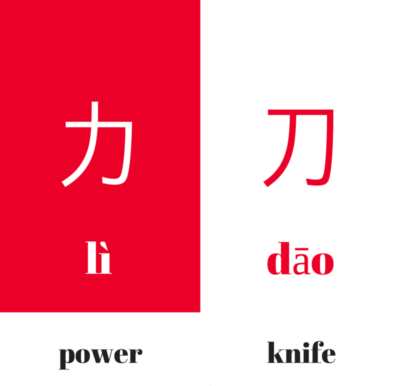
/ (lì/dāo) power/ knife

1-e1466158958266

Difference: The balance of these characters is slightly different, as the  (dāo) character is larger and takes up the whole ‘space’. The  (héng) stroke of the  (lì) character should begin lower, allowing for the downward curving stroke, known as  (piě), to begin above the horizontal stroke.

Examples of  (lì):

努力 (nǔ lì) – to try hard

压力 (yā lì) – pressure

Examples of  (dāo):

刀子 (dāo zi) – knife

剪刀 (jiǎn dāo) – scissors

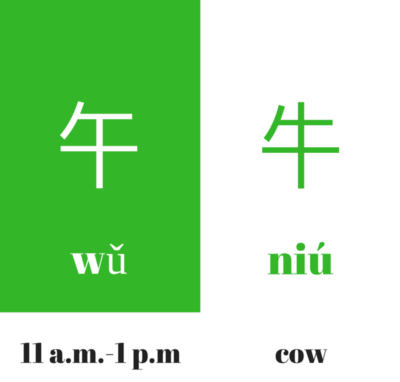
/ (wǔ/ niú) 11 a.m.-1 p.m/ cow

2-e1466158896372

Difference: The tip of the vertical stroke on the  (niú) character, known as  (shù), begins slightly above the first horizontal stroke,  (héng).

 (wǔ) is rarely used on its own, and often found in time phrases like in the following:

Examples of  (wǔ):

下午 (xià wǔ) – afternoon

上午 (shàng wǔ) – morning

Examples of  (niú):

牛肉 (niú ròu) – beef

牛奶 (niú nǎi) – cow’s milk

/ (yǐ/ jǐ) already/ self

3-e1466158756421

Difference: Two of the more difficult characters to distinguish between,  (yǐ) and  (jǐ) are almost identical apart from a tiny extra line in the  (yǐ) character. The  (shù) stroke begins above the second horizontal stroke.

Examples of  (yǐ):

已经 (yǐ jīng) – already

早已 (zǎo yǐ) – a long time ago

Examples of  (jǐ):

自己 zì jǐ – oneself

知己 zhī jǐ – to know oneself

How to Learn Chinese Characters with Mnemonics

With some characters, creating mnemonics can help with distinguishing between similar looking characters. A mnemonic can be a story or pattern of letters that can help you to remember something longer or more complex. A Chinese character mnemonic can help remind you of as many elements of the character as you want, meaning, tone, pronunciation etc.

/ (mǎi / mài) buy / sell

mai-e1466158635503

A simple mnemonic to distinguish between  (mǎi) and  (mài) is that if you ‘sell’  (mài) something you will receive money (maybe ten  (shí) ?). The character  (shí) can be seen added to the top of the  (mǎi) character to make  (mài).

You can apply a mnemonic to any character to remember it. You can visit our Online Dictionary and view existing mnemonics or even post your own ideas.

How to Learn Chinese Characters with Radicals

Radicals are the ‘building blocks’ of Chinese characters. They are most often on the bottom or the left side, and indicate the ‘meaning’ of a character. For example, the character  (kǒu) is also used as a radical and means ‘mouth’. Therefore, the radical  (kǒu) is often found in words that relate to the mouth, such as  (jiào), meaning to shout or  (chī) meaning to eat. In order to learn Chinese characters properly, it’s a good idea to start acclimatizing yourself with some of the basic radicals.

You can learn about some of the more common Radicals here. You can find the radicals for all the characters you learn by checking them in the Written Chinese Dictionary, both online and in themobile app. Just search for the character and you will a ‘Radical Breakdown’ for that character.

For a more comprehensive list of radicals, take a look at the radical feature in our Written Chinese Dictionary app.

Radicals can be one of the best ways to distinguish between Chinese characters, especially as the right hand side of the character often refers to (but not always) the pronunciation of a character.

Let’s look at these characters for example:

线/ (xiàn/qián) line/money

xian-e1466158526941

Both characters contain the same part:  (jiān). It would be very easy to mix up these characters, if you did not pay attention to their specific radicals.

Both characters, 线 (xiàn) and  (qián) , take their pronunciation from  (jiān) that we see on the right hand side. The meaning of the first character 线 (xiàn), is ‘line’ or ‘thread’ and is dictated by the radical on the left hand side, 纟(sī), which represents a bolt of silk. The second character,  (qián), has the radical for ‘gold’ ,钅(jīn) which tells us that the meaning of the character is ‘money’ or ‘coins’.

Here are some other examples of characters that look alike, but can be differentiated by their radicals.

/ (nà/nǎ) that/how

6-e1466158135453

The character  (nǎ) features the  (kǒu) radical, meaning mouth. The  (kǒu) radical, as mentioned above, is often used for characters relating to the mouth. It is also used in some question words including  (ma) and  (nǎ).

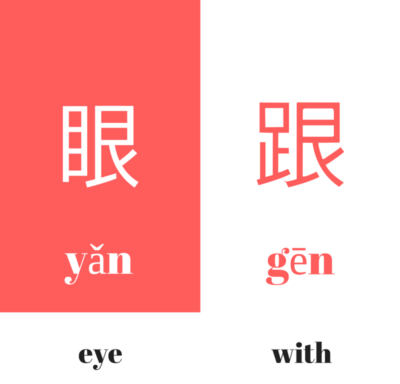
/ (yǎn/gēn) eye/with

7-e1466157665510

The right hand part of the character is 艮 (gèn) and provides the pronunciation for  (yǎn) and (gēn). The radical for the  (yǎn) character is  (mù), meaning eye. The radical found in the (gēn) character is  (zú) or foot. The foot radical is used here because the full meaning of  (gēn) is ‘close behind’ or the ‘heel’ of a foot.

Exercises

If you want to test your character recognition, complete these simple exercises and we’ll post the answers later!

1. Add another stroke to the  (rì) character to make new ones (hint: you can make around 9 characters).

2. Find the ‘wrong’ character in the sentences.

a. 我己经吃过饭了。(wǒ jǐ jīng chī guò fàn le.) I have finished the meal.

b. 下牛去看电影好吗? (xià niú qù kàn diàn yǐng hǎo ma?) How about going to the cinema this afternoon?

c. 妈妈没有告诉我他去哪儿了。(mā ma méi yǒu gào su wǒ tā qù nǎr le) Mom didn’t tell me where she was going.

Welcome to have my face to face lesson on http://www.verbling.com/teachers/dawei  !  🙂

Chinese story: 小男孩和雨伞 The little boy and the umbrella

小男孩儿和雨伞 xiǎo nánhái hé yǔsǎn

yí gè xiǎo nánhái hé jiārén yìqǐ qù wàimian sànbù. hūrán xiàyǔ le, kěshì tāmen zhǐ dài le yì bǎ yǔsǎn.

一个小男孩和家人一起去外面散步. 忽然下雨了, 可是他们只了一把雨伞.

bàba bǎ yǔsǎn gěi māma, māma bǎ yǔsǎn gěi gēge, gēge kànkan dìdi, yòu bǎ yǔsǎn gěi le xiǎo nánhái.

爸爸把雨伞给妈妈,妈妈把雨伞给哥哥, 哥哥看看弟弟, 又把雨伞给了小男孩.

xiǎo nánhái wèn:“ wèishénme bàba bǎ yǔsǎn gěi māma, māma gěi gēge, gēge yòu gěi wǒ ne?”

小男孩问:”为什么爸爸把雨伞给妈妈,妈妈给哥哥,哥哥又给我呢?”

bàba huídá:” yīnwèi wǒ bǐ māma qiángdà, māma bǐ gēge qiángdà, gēge yòu bǐ nǐ qiángdà.”

爸爸回答: ” 因为我比妈妈强大,妈妈比哥哥强大,哥哥又比你强大.”

xiǎo nánhái kànzhe miànqián de xiǎohuār xiǎocǎo, tāmen zài fēngyǔ zhōng yáoyáohuànghuàng de, hǎoxiàng zài shuō: “kuài lái bāngbang wǒmen ba.”

小男孩看着面前的小花儿小草, 它们在风雨中摇摇晃晃的, 好像在说: “快来帮帮我们吧.”

zhèshí xiǎo nánhái bǎ yǔsǎn dǎkāi, qīngqīng de fàng zài le huā cǎo de biānshang, jiù xiànggěi huācǎo dājiàn le yī suǒ línshí de xiǎo fángzi.

这时小男孩儿把雨伞打开,轻轻地放在了花草的边上就像给花草搭建了一所临时的小房子。

Vocabs:

外面 wài mian: outside

散步 sàn bù: take a walk

忽然 hū rán: suddenly

带 dài: to take, to bring

回答 huí dá: to answer

强大 qiáng dà: strong

看着 kàn zhe: to look (at), looking (at)

面前 miàn qián: in front of (him/them)

在风雨中 zài fēng yǔ zhōng: in the rain and wind

摇摇晃晃yáo yáo huàng huàng: shaking, trembling

好像在说 hǎo xiàng zài shuō: as if they are saying

轻轻地 qīng qīng de: gently

放 fàng: to put, to place

边上 biān shang: on the side of… same as 旁边 pángbiān

就像 jiù xiàng: just like

搭建 dā jiàn: to build

临时 lín shí: temporary

The little boy and his umbrella

A little boy went out to have a walk with his family. All of a sudden it started to rain, they had only one umbrella. Dad gave mom the umbrella, and mom gave it to elder brother, but the elder brother didn’t keep it for himself either and gave it to the little boy, his younger brother.

“Why you all passed the umbrella to me? “The little boy asked.

Because I am stronger than your mom, mom is stronger than your brother, that makes you the least strong in the family, so you get the umbrella.” Answered his dad.

The little boy looked at the little flowers with grass in front of them, as if they were crying for help, he then decided to protect the less strong. He gently placed the umbrella next to the delicate flowers. As if he just built a temporary house for those delicate flowers.


Chinese Online Mini Story – Breakup (Beginner to Elementary)

This Learn Chinese short story is written for beginner to elementary level readers. Sentence patterns are simple. You can learn a few new words along your reading. No pressure, take your time. I assume most of my readers are adults or even older teenagers. You really don’t need to start with kids’ stories. I hope my short stories can give you some simple Chinese to read in adulthood.

[simplified Chinese and pinyin]

fēn shŏu


hěn wǎn le。

很晚了。

It was deep in the night.


tā, yīgèrén zuò zhe。

他,一个人坐着。

He was sitting all alone.


zhuō shàng shì kōng jiǔ píngzi。

桌上是空酒瓶子。

There were empty wine bottles on the table.


tā hé tā fēnshǒu yǒu shí gè xiǎoshí le。

他和她分手有十个小时了。

Ten hours had passed since the two of them broke up.


tā zhǐ juéde yè hěn cháng, yě hěn liáng。。。

他只觉得夜很长, 也很凉。。。

He only felt the night was too long, and too cold …


ér tā, zhèng zuò zài huǒchē shàng, xiǎng zhe tāmen

fēnshǒu de xiàwǔ。

而她,正坐在火车上,想着他们分手的下午。

And she, who was riding on a train, was thinking about the afternoon that they broke up.


bù jìde tāmen wèishénme zhēngchǎo。

不记得他们为什么争吵。

She couldn’t remember how the fight started.


kěshì tāmen dōu hăn chū le” fēnshǒu” liǎng gè zì。

可是他们都喊出了分手两个字。

However both of them tossed out the word “breakup”.


jiù zhè yàng, tā men yĭ fēn shŏu jié shù le sān nián de ài qíng。

就这样,他们以分手结束了三年的爱情。

Just like that, they broke up and ended their three years’ relationship.


[simplified Chinese without pinyin]


很晚了。

他,一个人坐着。

桌上是空酒瓶子。

他和她分手有十个小时了。

他只觉得夜很长, 也很凉。。。


而她,正坐在火车上,想着他们分手的下午。

不记得他们为什么争吵。

可是他们都喊出了”分手”两个字。

就这样,他 们 以 分 手 结 束 了 三 年 的爱 情。


[traditional Chinese]

分 手 


很晚了。

他,一個人坐著。

桌上是空酒瓶子。

他和她分手有十個小時了。

他只覺得夜很長, 也很涼。。。


而她,正坐在火車上,想著他們分手的下午。

不記得他們為什麼爭吵。

可是他們都喊出了”分手”兩個字。

就這樣,他 們 以 分 手 結 束 了 叁 年 的 愛 情。


[vocabulary table]

Simplified Chinese Traditional Chinese Mandarin Pinyin English Definition
jiu3 wine
瓶子 瓶子 ping2 zi5 bottle
分手 分手 fen1 shou3 to split up; to break up;
小时 小時 xiao3 shi2 hour
觉得 覺得 jue2 de5 to think; to feel;
ye4 night;
liang2 cold; cool;
争吵 爭吵 zheng1chao3 dispute; strife;
jiu4 just (emphasis);
结束 結束 jie2 shu4 to finish; to end;
爱情 愛情 ai4 qing2 romance; love (romantic)


How to learn Chinese more efficiently and quickly?

a

Learning to speak Chinese isn’t rocket science. There are some things you can do to make it painless or nearly so. You should speak to Chinese people when you get a chance, and in their native tongue. Doing so can improve your Chinese fluency quickly.

Learning to Speak Chinese

b

Learn some basic vocabulary. The first thing to do when learning a new language is to memorize some simple yet important words and start practicing with them as soon as possible. Although things like grammar and sentence structure are important, they mean nothing until you develop a basic vocabulary. Here’s a short list to get you started:

  • Hello = nǐhǎo, pronounced [nee hauw] With 2 third tones. Not “ho” or “how” somewhere in the Listen to a native speaker as a reference.
  • Yes = shì, pronounced [sher]” But not as in “sure”.

ALWAYS listen to a native speaker, as describing with English pronunciations in the learners minds will be difficult.

  • No = bú shì, pronounced [boo sher] look abo
  • Goodbye = zài jiàn, pronounced [zai jee-ian]
  • Morning = zǎoshàng, pronounced “[zauw-shaung- hauw]”
  • Afternoon = xià wǔ, pronounced There is almost no clear way to describe the “x” in pinyin with English pronunciation Look it up and listen to a native speaker say it. Contrary to popular misinfomation,

the “x” DOESN’T AT ALL sound like “sh”!

  • Evening = wǎn shàng, pronounced [wang shaung]
  • Head = tóu, pronounced [toe] with a 2nd tone, that goes up.
  • Feet = jiǎo, pronounced [jee-yau]
  • Hands = shǒu, pronounced [show] With a 3rd tone, this goes from neutral to lower to neutr
  • Beef = niú ròu, pronounced [nee-o row] but not with the soft “r”, more defined “r”.
  • Chicken = jī, pronounced [jee]
  • Egg = jī dàn, pronounced [jee dan] “dan” has a 4th tone, that goes do Slightly forceful sounding. (not too forceful sounding!)
  • Noodles =miantiao pronounced [miàn tiáo]
  • Always look up pronunciations of every word spoken by a native speake Most Mandarin pinyins just simply cannot be described perfectly with English sounds!

c

2

Learn some basic phrases. Once you’ve built up a little vocabulary, you can start working on some basic phrases and expressions that will help you to navigate everyday conversations. Here’s a few to get you started:

  • How are you? = nǐ hǎo ma? pronounced [nee hau mah] (see above for pronunciations)
  • I’m fine = wǒ hěn hǎo, pronounced [wuh hen hau]
  • Thank you = xiè xiè, pronounced There is almost no clear way to describe the “x” in pinyin with English pronunciation Look it up and listen to a native speaker say it. Contrary to popular misinfomation, the “x” DOESN’T AT ALL sound like “sh”! The “ie” part sounds close to “yieh”
  • You’re welcome = bú yòng xiè, pronounced [boo yong xi-yeh]
  • Sorry = duì bu qǐ, pronounced [dway boo qi] Like with the Mandarin “x” a proper pronunciation described with English letters is almost impossible. As always, I can’t stress enough the importance of looking up native speakers pronouncing the pinyin.
  • I don’t understand = wǒ bù dǒng, pronounced [wuh boo dong]
  • What is your surname (family name)? = nín guì xìng, pronounced [neen gway xing] (I’m sure you know by now why I just put “x” instead of the phonetic)
  • What’s your name? = nǐ jiào shén me míng zì, pronounced [nee-jee-yow shen-ma ming zi]”
  • My name is      = wǒ jiào          , pronounced [wuh jee-yau]

d

3

Learn the tones. Chinese is a tonal language, which means that the same word can mean different things depending on the tone used to express them (even if the spelling and pronunciation are the same). This can be difficult for English speakers to grasp, but learning the tones is essential if you want to speak Chinese properly. There are four major tones in Mandarin Chinese, as well as a neutral tone:

  • The first tone is a high, flat t It is expressed in a relatively high voice, with no rising or dipping. Using the word “ma” as an example, the first tone is expressed in writing as “mā”.
  • The second tone is a rising t It starts at a lower level and gets progressively higher, like when you say “huh?” in English. The second tone is expressed in writing as “má”.
  • The third tone is a dipping tone. It starts at a medium level, then dips lower before rising again, like when you say the letter “B” or the word “horse” in English. The third tone is expressed in writing as “mǎ”.
  • The fourth tone is a falling t It starts at a medium level and gets progressively lower, like when you are giving a command (such as telling someone to “stop”) in English. The fourth tone is expressed in writing as “mà”.
  • The fifth tone is a neutral t It does not rise or fall, like the first tone, but this tone is expressed in a flat voice.. The fifth tone is expressed in writing as “ma”.

e

4

Work on your pronunciation. Once you have learned the correct pronunciation of the tones by listening to native speakers (Youtube is good for this) and practicing them yourself, you need to work on applying them to words.

  • This is essential, as the same word can have a completely different meaning depending on which tone is use For example, using the tone “mā” instead of “má” could be the difference between saying “I want cake” and “I want coke” — two completely different meanings.
  • Therefore, when you’re learning vocabulary, it is not enough to learn the pronunciation, you must also learn the correct Otherwise you could use the word in the wrong context and be completely misunderstood.
  • The best way to work on your pronunciation is to speak with a native Chinese speaker who can encourage you when you get it right and correct you when you’re wrong.

f

5

Work on grammar and sentence structure. It’s a common misconception that Chinese is a “grammar- less” language. Chinese has quite a complex grammar system, it’s just very different to that of English and other European languages.

  • Luckily, when learning Chinese you will not have to learn any complicated rules involving verb conjugations, agreement, gender, plural nouns or tense. Chinese is a very analytic language, which makes it quite simple and straightforward in some respects.
  • Another bonus is that Chinese uses a similar sentence structure to English — subject-verb-object — which makes translating back and forth between the two languages somewhat easier. For instance, the sentence “he likes cats” in English is translated as “tā (he) xǐ huan (likes) māo (cats)” in Chinese even when the pronouns change!
  • On the other hand, Chinese has its own grammar structures which are very different to those used in English and can therefore be very difficult for the English speaker to g These grammatical features include things like classifiers, topic-prominence and preference for aspect. However, there’s no point in worrying about these things until you’ve mastered basic Chinese.

Learning to Read and Write in Chinese

g

1

Learn pinyin. Pinyin is a Chinese writing system which uses letters from the Roman alphabet instead of Chinese characters.

  • It is useful for Chinese language learners as it allows you to get started with reading and writing Chinese without the time involved in learning traditional character There are many Chinese textbooks and learning materials available in Pinyin.
  • However, it is important to be aware that even though Pinyin uses letters from the Roman alphabet, its pronunciation is not always intuitive to the English speaker. Therefore, it is important to use a proper pronunciation guide when learning Pinyin.

h


2

Learn to read some Chinese characters. Although the ability to read traditional Chinese characters is not necessary for learning Chinese, the idea appeals to many people and makes them feel more in touch with traditional Chinese culture.

  • Learning to recognize and read Chinese characters is no easy t In order to read a newspaper, the average Chinese reader will need to be familiar with about 2000 different characters — and that’s just the beginning. It is believed that there are over 50,000 Chinese characters in total (though many of them are no longer in use).
  • The major benefit of learning to read Chinese characters is that you will have access to a broad array of other literatures, including Cantonese, Japanese and Korean — all of which use Chinese characters (or a simplified version of them) in their writings, despite the fact that the spoken languages are very different.

i

3

Learn to write some Chinese characters. Once you have learned to read Chinese characters, you may be interested in learning how to form them yourself. Writing Chinese characters is a complex skill, which requires patience and a touch of artistry.

  • The first step in learning how to write Chinese characters is to learn the “radicals” — these are the individual brush strokes that form the building blocks of each cha There are 214 radicals in total — some can stand on their own as individual characters, while others are only used as part of a more complex character.
  • When writing Chinese characters, the order of the brush strokes is very important and you must follow a specific set of rules — such as top to bottom, left to right and horizontal before If the stroke order is incorrect, the completed character will not be accurate.

j

4

Read Chinese texts. If you want to improve your Chinese reading skills, you’ll need to practice a little reading for at least 15 to 20 minutes a day.

  • To begin with, you could try using some children’s readers or workbooks (which are nearly always written in Pinyin) to practice your basic reading skills.

You should also be able to find some good resources for reading Chinese online.

  • You can also try to incorporate your Chinese learning into your everyday lif You can do this by reading the Chinese labels on food products at the Asian supermarket, or asking your server for the Chinese language menu at a restaurant.
  • Once your reading becomes more advanced, you could try to get your hands on a Chinese newspaper (which are printed using traditional Chinese characters) and do your best to read through the article This is also a good way of familiarizing yourself with Chinese culture and current affairs.

k

5

Write a little Chinese everyday. In order to practice your Chinese writing skills, you should try to write a little everyday, whether in Pinyin or in Chinese characters.

  • One option is to keep a small personal diary in Chinese, where you write down simple things like a description of the weather, how you are feeling that day, or what you did. If you’re not to shy about it, you could ask a Chinese-speaking friend or acquaintance to look it over and check for any mistakes.
  • Alternatively, you could try to find a Chinese pen-pal to write letters t This could be mutually beneficial, as you could get some practice writing in Chinese, while your pen-pal could practice their English. You could also ask your pen-pal to include the corrected version of your original letter when replying.
  • A last way of practicing your writing is to make simple lists in Chinese, like your shopping list, or to make Chinese labels for items around the house.

Immersing Yourself in the Chinese Language

l

1

Practice with a native Chinese speaker. The absolute best way to learn Chinese is just to speak it with a native speaker — this will force you to think on your feet, help with your accent and expose you to more informal or colloquial forms of speech that you won’t find in a textbook.

  • If you have a Chinese-speaking friend, ask them if they’d be willing to sit down with you for an hour or two each week. They’d probably be happy to help — as long as the coffee’s on you!
  • If you don’t know any Chinese speakers personally, you could try placing an ad in your local paper or online for Alternatively, you could look into finding a Chinese conversation group or oral Chinese class in your local area.
  • If all else fails, you could try to connect with a Chinese speaker on Skype, one who’d be willing to exchange 30 minutes of Chinese conversation for 30 minutes of English.

m

2

Listen to Chinese tapes/CDs. Listening to Chinese podcasts or CDs is a great way to immerse yourself in the language — even when you’re on the go!

  • It doesn’t matter if you can’t follow everything that’s being said — just try to be an active listener and attempt to pick out key words and phrases. Slowly but surely your overall comprehension will improve.
  • This is a great option for people who have long commutes as they can simply stick a Chinese CD on in the car or listen to a Chinese podcast on the You could also try listening while exercising or doing housework.

n

3

Watch Chinese films and cartoons. Watching Chinese films and cartoons is a more fun, relaxed way of immersing yourself in the language, however, it will still help to expose you to the sounds and structure of Chinese.

  • Try watching short cartoons or clips on Youtube, or rent a full length Chinese film from your local movie stor You may need to use subtitles at first, but try not to rely on them too much — see how much of the dialogue you can understand on your own.
  • If you’re feeling particularly proactive, you could pause the film after particular words or phrases and try to repeat them — this will help your accent to sound more authentic.

o

4

Don’t be afraid of making mistakes. The biggest obstacle that will stand in your way of learning Chinese is your fear of making mistakes.

  • You need to try to overcome this fear — and even embrace it — if you are to reach your goal of fluency.
  • Remember that everyone makes mistakes when they are learning a new language, and you are bound to have your fair share of embarrassing mistakes and awkward moments, but this is all part of the process.
  • Remember that you are not aiming for perfection when you are learning Chinese, you are aiming for progres So go ahead and make as many mistakes as you like — as long as you learn from them and continue to improve.

p

5

Consider taking a trip to China. Can you think of a better way to immerse yourself in the Chinese language than a trip to its native land?

  • China is an amazingly diverse country — from the busy, bustling streets of Beijing to the ancient majesty of the Great W There is something for every traveler — whether you’re looking to immerse yourself in traditional ethnic cultures, to sample the many delicious Chinese delicacies or to travel to the sites of ancient ruins and epic battles.
  • Alternatively, you could take a tour of other places with large Chinese-speaking populations, like Taiwan, Malaysia, Singapore and the Philippine Just make sure that you are prepared for differences in dialect (not all are mutually intelligible) before you book your flight!

Welcome to have my face to face lesson on http://www.verbling.com/teachers/dawei  !  🙂


If you want to Learn Chinese, you shall know these.

From one long-term student of Chinese, to all those who aspire to achieve a working knowledge of this fascinating language, here are the top five insights:


  1. Understand that Chinese, while difficult, can also be very easy to learn.

Most people believe that Chinese is one of the most difficult languages in the world. In some senses, this is true. The Chinese writing system is non-alphabetic, comprising thousands of pictographs called “characters,” which need to be studied and internalized through rote memorization and constant reading and writing over a long period of time. Additionally, Chinese is a “tonal” language, meaning that changing the shape of one’s voice over a single syllable can actually generate multiple words with multiple meanings. The most famous example in Mandarin Chinese is the syllable “ma” which, depending on how it is pronounced, might mean “mother,” “hemp,” “horse,” or the verb “to scold.” This is a feature of the spoken language which does not exist in the same form in Western languages, and therefore can pose great challenges to many non-Asian students.

However, what most non-Chinese do not realize is that the language boasts one of the easiest grammars in the world. Sentence structure largely mirrors that of English (subject + verb + object). Verbs exist in a single form, with no conjugations whatsoever. There is no gender, no plural nouns, and while mechanisms do exist to express tense (e.g. past/present/future), they are much simpler than those of any Western language. North American students who are much more familiar with both Spanish and French would instantly find Chinese grammar refreshingly basic, and much more accessible than those languages.

  1. Learn Mandarin, not Cantonese.

There are literally hundreds, if not thousands, of regional and local spoken Chinese dialects which have developed over the long period of China’s classical history when transportation was rudimentary, broadcast media non-existent, and most people lived and died within a small radius of their birth places. Although speakers of all Chinese dialects share the same, non-phonetic written language, many of the dialects are mutually unintelligible when spoken, giving rise to the unique ability of Chinese speakers from different regions to write to each other, even when they cannot speak with each other. Among Chinese who have emigrated, the two most common spoken dialects are Mandarin and Cantonese. Historically, Cantonese dominated within the largest Chinese communities in the United States and Canada due to a century of Chinese immigration rooted in the southern Chinese regions of Guangdong (Canton) Province and Hong Kong. However, with the recent massive influx of Mainland Chinese, Mandarin-speaking immigrants in the last 20+ years, Mandarin will soon match, and eventually overtake, Cantonese to become the dominant spoken Chinese dialect in North America.

For non-Chinese seeking to learn the language, Mandarin is the clear choice. Mandarin, the predominant dialect in Northern China, is the official language of politics, education, and media in both Mainland China and Taiwan, and it is one of the four official languages of Singapore. Even in Hong Kong, which historically has been a Cantonese-speaking area, Mandarin use is now ubiquitous since the return of China’s sovereignty in 1997. In Mainland China, the Chinese word for “Mandarin” translates as the “common language,” and outside of the Mainland it is most often referred to as the “national language” — both these terms are indicative of the broad reach which a competency in Mandarin can afford a speaker. Fortunately, for students of Chinese, Mandarin is also arguably the easiest of all the Chinese dialects to learn, owing to a “tonal” structure which is much simpler than that of Cantonese and most other dialects.

  1. Speak first, then decide if you need to read and write.

Given the complexity of the Chinese written language, contrasted to the comparative simplicity of the grammar, prospective students of Chinese would do well to focus on learning to speak first, and only then tackle the written language if their studies or business require them to do so. While the tonal character of the spoken language is a challenge, this can be mastered fairly quickly, in contrast to the many years needed to achieve a working familiarity with the several thousand written characters that most educated Chinese adults have learned. Of course, most Chinese language programs simultaneously teach both the spoken and written language. It is up to the individual student to decide where to emphasize his or her needs.

  1. If you do decide to write Chinese, consider learning “simplified” characters.

There are two major Chinese writing systems currently in use in the world — “traditional” or “complicated” Chinese characters, and “simplified” Chinese characters. Traditional characters are the characters which evolved from ancient Chinese pictographs, and which have been used throughout most of Chinese history to modern times. Many of these characters are, at the same time, both beautiful and complex, requiring students of Chinese to spend many hours and nights practicing intricate “stroke orders” to properly form words. Beginning in the middle of last century, the government in Mainland China began to promulgate an alternate system of Chinese writing called “simplified” characters in an effort to dramatically increase written literacy throughout the country. For many characters, this system significantly reduces the number of brush or pen strokes required to form specific words, thereby enabling students to more quickly commit the characters to memory.

Today, simplified characters are the official script of both Mainland China and Singapore, while traditional characters are still the norm in Taiwan, Hong Kong, and within most Chinese immigrant communities throughout the world. While I would still encourage students of Chinese who intend to spend many years developing and refining their abilities to begin by learning traditional characters (and only then overlay a knowledge of simplified characters), anyone seeking to accelerate his or her acquisition of the written language would do well to begin with the simplified script.

  1. Take your studies seriously.

Unlike many Western languages which share some common linguistic roots with English and which can often be learned fairly quickly with a large amount of self-study, acquiring a basic competency in a language as different from English as Chinese requires a high level of commitment and perseverance. Practically speaking, this means that:

  • Unless you have an unusual aptitude for learning foreign languages, you probably won’t learn Chinese in a once-a-week, one-hour private session. Rather, start by looking for an established Chinese language program or workshop. Universities and dedicated language schools are a good place to start. Some colleges even offer intensive courses that cram a full year of basic Chinese into 4-8 weeks. Do your homework to find the best program.
  • If you still seek a tutorial, merely looking for a native speaker of Chinese to study with does not always mean you will obtain the best instruction. Chinese immigrants constitute the single largest Asian American population, representing 3+ million people nationwide, many of whom would be happy to teach new students of Chinese. However, teaching Western students to overcome the unique hurdles of the language is a special skill. If you decide on private lessons, look for a native-speaker with proven professional or private teaching credentials, as well as a roster of former student references.
  • Finally, practice, practice, practice. The good news is that those 3+ million Chinese Americans are our neighbors. Once you have developed basic conversational skills, go into the top Chinese communities of our country and speak. Order a lunch, buy a book, chit-chat about the weather, or ask for directions — even if you don’t need any! Westerners who have mastered Chinese will also unanimously confirm that real fluency comes only when one has spent some time in a Chinese-speaking region of Asia. So, get ready for your next business trip, take advantage of the many short-term or long-term Chinese language courses available in China, Taiwan, Hong Kong, or Singapore, or just plan a personal or family adventure to Asia.

One of those very famous Chinese sayings says, “A journey of a thousand miles begins with a single step.“ Well, it definitely does not need to take a “thousand miles” to learn Chinese, but now, more than ever, is the time for more Americans to take that first step.


How to Learn Chinese Fast: 7 Steps

Many students often ask me: Hey David, how to learn Mandarin Chinese fast? Maybe in 3 or 5 days?

Me: Are we talking about A.I. or something?

Questions like this tells me that there are some misconceptions about learning a language. Since there are too many “fast-food” language-learning advertisements around us, we are easily misguided into believing that learning a new language can`t be easier and faster. I can confidently say that learning Chinese as a second language is not a three or five-day thing. Of course, it is not considered mastery if you just know “你好(nǐ hǎo)”, “谢谢(xiè xie)” and “我很好(wǒ hěn hǎo)”. Nevertheless, you shouldn’t be afraid of learning Mandarin Chinese. There are ways to make your learning more efficient and faster through a more logical method. Here are seven steps that will help you how to learn Chinese fast.

1. Do basic research

There is a Chinese saying, “磨刀不误砍柴工”, which means “the more the preparation, the faster work gets done.” To begin with, you need to do some basic research about your target language, Mandarin Chinese. There are thousands of articles and videos that introduce the Chinese language. You should read and view these to know the language’s general history and how it works. Several questions that could arise are:

Why are there traditional and simplified Chinese characters?

Which one should I learn?

Why are Chinese characters made of strokes and not letters? What is the history behind this?

What is the difference between Mandarin and Cantonese?

Are 汉语(hànyǔ), 中文(zhōngwén) and 普通话(pǔtōnghuà) the same?

What is your learning goal?

How long would you like to spend on learning this language?

……

During your research, you may find the answers to these questions and decide the right and suitable way to go to learn the language.

2. Lay a solid foundation

I`m often asked if learners can just skip the boring beginning part and learn the “useful” and “practical” conversation part. Well, if you are in a hurry and just want to grab several basic greetings to warm up the meeting with Chinese people, then yes, you can just imitate some greetings directly. However, these greetings won`t take you far. If you are a serious learner who wants to have a longer and more meaningful conversation with Chinese people, take some language tests, or live in China, a solid foundation of the Chinese language will make your learning easier and give you fewer obstacles. In other words, you can learn Chinese faster and better. All in all, a good beginning is half the battle.

So, what the is the foundation of Chinese? The first foundation should be the Pinyin system. It is definitely necessary and never too late to make sure your pronunciation is correct, but how? The answer is to start from the basics, such as the tone, the final, the initial, the spelling rules, etc. I wrote a complete pronunciation guide which should give you a general idea about how to best learn Chinese pronunciation. After this stage, you can spell all pronunciation of Chinese characters out automatically with no hesitation. Good pronunciation will make your communication with Chinese people more smooth without any misunderstandings when speaking.

Besides pronunciation, another foundation is learning Chinese characters. You may wonder why Chinese characters are necessary. Are they worth learning? Yes, you can learn some basic sentences even if you don`t know any Chinese characters. But with that method, you need to make sure you have a very good memory and be immersed in an everyday Chinese speaking environment, so that you will not forget the content you learned through listening and repeating. But without a doubt, you will definitely lose the ability to read and distinguish many Chinese homonyms. Without knowing Chinese characters, you have no way to be an advanced or even an intermediate learner. If you learn simple characters from the beginning, you may find it`s not that difficult to learn especially when you get past the first stage. There are four main Chinese Characters types, and learning the basic characters stroke by stroke will lay a good foundation and benefit your future learning.

3. Master the knowledge points and link them together: make a logical net

Whenever we speak of knowledge points, grammar comes to our minds immediately. It seems there are many grammar points to learn during the whole language learning process. However, as I always claim, Chinese grammar is really not as difficult as you think. We don`t even need to change the tense and gender in Chinese, unlike in other languages. Using English speakers as an example, you should know the difference between English and Chinese first, then this can give you a better overview of the target language. And if you have learned some rules on the periods of time, you can summarize most of the grammar points into one sentence structure:

Subject + time preposition + Time + location preposition + Location (from the biggest to the smallest) + how (can be adverb or a phrase containing a preposition.) + Verb + time duration + indirect object + Object

With this structure, you can solve many Chinese grammar problems. The process you learn to summarize those grammar points is the key to link them together and make a whole knowledge net. What you need to do is put the new point in the right position of the grammar net.

1

As you can see, the picture above also shows us a net for learning vocabulary. You can start with a topic that interests you such as shopping or playing sports. Write down this main topic in the middle of a big sheet of paper. Add branches from the main topic and use related phrases or words as the titles. This method also works when learning Chinese characters. It`s a fun and easy way to start building your vocabulary of Chinese characters through a continuous and vivid approach.

2

4. Sharpen your learning method

How to learn Chinese fast? Choosing the right and suitable way for you to learn a language can make you learn faster. Generally speaking, there are two ways to learn: self-learn, or learn with a tutor. No matter which way you choose, the method and tools of each way are important to know.

Self-learning
As a self-learner, the ability to collect high quality learning materials and resources is necessary. The development of internet technologies has been constantly changing the process of learning a foreign language, and we should use the maximum available online tools to do so. A complete resource website can help a lot, such as DigMandarin. You can find all Chinese learning skills, materials, resources, and even courses there. It is quite convenient to have it all in one digital place. There are also lots of online libraries where you can browse textbooks for free. If it fits your need, you can buy them on Amazon or other online bookstores. When you drive or are stuck in traffic, you can listen to some podcasts to strengthen your Chinese listening, such as Chinese Class 101 and ChinesePod. At home or at the office, you can also attach some individualized flashcards somewhere conspicuous to remind you of some related vocabulary every now and then. During your own study time, you can focus on a selected textbook or on an online Chinese video course. For sure, more study APPs have come out now. You can try various APPs and take advantage of your learning time. If you use these tools properly, you can definitely control your learning better.

Learn with a tutor
“A professional Chinese tutor can save you quite a lot of time if your goal is to learn Chinese fast, primarily because a Chinese tutor can offer you one-on-one instruction that is tailored to meet your specific needs and abilities.” At your own convenience, you can choose an online or an offline Chinese school. Online learning is quite convenient for learners who have requirements about time and place. No matter where you are, you can start to learn anytime. Without the limitation of time and place, offline local language school is your best choice. Face to face communication can boost your passion for this language and make you more Chinese speaking friends. All in all, a professional tutor can save you lots of time to achieve your goal.

5. Immersion learning: make your own language environment

Language is a kind of communication tool. If you don`t use it, you will obviously lose it. Sometimes, no letting-down in your learning is also a sign of progress. Therefore, we need to keep activating our senses for reading, listening, speaking, and writing. Find your own way to make an environment for the Chinese language and immerse yourself in it.

“Living in” the target language is the ideal way to acquire it amazingly fast. It pushes you to keep involving yourself fully with the language. Thus, the best way is to try to live in China for a period of time, if you can. Of course, don`t just be with non-Chinese speakers everyday. Make more Chinese-speaking friends! Those everyday first-hand local Chinese language terms and sayings are not found in the textbook.

But how about if you can`t be in China? Then you`re lucky if you happen to have Chinese speaking family-members, classmates, colleagues, or neighbors around you. It`s very easy to develop a Chinese-speaking environment. I know some of you are embarrassed to trouble others, but what you can do is call all the Chinese learners of your community together and make a Chinese corner. You can then all learn together! Or you can also find someone to learn with as your language partner.

As the saying goes, “interest is the best teacher”. Even light-hearted activities can also help you immerse in the language. You can watch Chinese TV series, Chinese movies, or listen to Chinese songs. You can enjoy the content and learn the language at the same time. This method works all the time.

6. Use it as much as you can

As a second language learner, I know Chinese students have a common problem, which is we often avoid speaking the target language out. Many Chinese are too shy to dare making mistakes, thus we just keep silent. Of course, we can`t acquire the language very well since we rarely use it in real life. Therefore, I keep telling my students and audiences, use Chinese as much as you can! Don’t be shy or afraid. Regardless of output, it`s not only about speaking, but also writing. Speaking and writing in Chinese can help you organize your knowledge and acquire it very well. Regarding input, listening and reading are the common methods to learn more of the target language. Many foreigners live in Shanghai or Beijing for several years, but they can only say 你好 and 谢谢. Why? Because they never use Chinese, only their daily social languages. It`s ok if they don`t even want to learn this language. But for you, a serious Chinese learner, just open your mouth and ears. Use the target language in your daily life, so that you know which part you need to improve or refresh.

7. Strengthen the weak parts and the useful parts

Setting an achievable goal is an effective method of study. For example, you can try to take some Chinese language tests like HSK or HSKK. The test itself is not the aim. Rather, we can get a direct and clear understanding of your Chinese level through the test. At the very least, your listening, reading, and writing skills can be tested by taking HSK. The results of each part are quite clear and objective. Then you would know which parts you need to improve on. Based on the Cannikin law, it is only if we strengthen the weak parts can we step forward to the next, higher level.

Besides the weak parts, we also need to strengthen the parts useful for us. For example, to a business Chinese learner, it`s really not necessary to learn many classroom expressions. After the foundation stage, we can start our target part. After all, language is a tool which we should use frequently. So now we can be back to our first tip: ask yourself why you want to learn Chinese? Don`t get lost in the language ocean. Always keep your focus on your language goals.

Strengthening these parts can not only encourage you, but can also help you learn Chinese as fast as you want.

Welcome to have my face to face lesson on http://www.verbling.com/teachers/dawei  !  🙂