The usage of Chinese character “就”

To kickstart today’s lesson, I’d suggest you to do a character search on a random Chinese article that you can pull out from the Internet. Just search for Chinese character (jiù) in the article. I bet you’ll be able to find it, not once, possibly a lot.

No doubt this is a high frequency character. You might be able to translate it as “will” in one place, but under other circumstances, it is combined with other characters to render various meanings. For that reason, it’s worthwhile to have a whole lesson just for it.

First of all, a few new words to go through first:

kāi shǐ kǎo shì xià yǔ 
开始 (start) 考试 (exam)  下雨 (rain)
qǔxiāo
 取消 (cancel)


See if I can put its usages all together into one list:

  • … will …    =>    … jiù(huì, yào) + verb …
  • … is …    =>   … 就是jiùshì… (emphasis on “is”)
  • Once … then …    =>    … jiù + verb …
  • right “where” …   or   right “when” …   =>   就在jiù zài

The easiest way to learn them is through examples. That gonna make our life easier… 🙂


… will …    =>    … () + verb …

rúguǒ míngtiān xiàyǔ, yīnyuèhuì jiù huì qǔxiāo.

如果明天下雨音乐会就会取消.

If it rains tomorrow, the concert will be canceled.


… is …    =>   … 就是… (emphasis on “is”)

tā jiùshì xiǎo lǐ de mèimei.

她就是小李的妹妹.

She IS Xiao Li’s sister. (confirmed)


Once … then …    =>    …  + verb …

wǒ dàoliǎo nàr, yīnyuèhuì jiù kāishǐ le.

我到了那儿音乐会就开始了.

Once I arrived, the concert started.


… right “where” …   =>   就在

tā de jiā jiù zài zhèr.

他的家就在这儿.

His home is right here.


… right “when” …   =>   就在

tā de kǎoshì jiù zài zǎoshang.

他的考试就在早上.

His test was right in the morning.


“就”can also appear in compound words to form different meanings other than above.

Hope today’s lesson would help you to learn how to use this high frequency character in your own spoken or written Chinese.

Welcome to have my face to face lesson on http://www.verbling.com/teachers/dawei  !  🙂


How to use character “ 着“ in Chinese

Character “ 着“ is a frequently used character that has no equavelant counterpart in English. There are also two ways to pronounce the mysterious character, I’ll show you how soon.

However, as scary as it sounds, it’s really not that difficult in terms of usage. Once you grasp it, and can use it freely, it’ll help you to “craft” your Chinese to be more “native”.

Before anything else, let’s go through your new vocabulary drill first. 🙂 :

pèng zhuàng zhuānxīn
[hanzi][/hanzi] (bump) [hanzi][/hanzi] (hit) [hanzi]专心 [/hanzi](concentrate)
jìng jìng dì yǔ shēng chē zi
[hanzi]静静地[/hanzi](silently) [hanzi]雨声 [/hanzi](sound of rain) [hanzi]车子[/hanzi] (car)
qiáng bǐ jì běn zhǎo
[hanzi][/hanzi] (wall) [hanzi]笔记本[/hanzi](note book) [hanzi][/hanzi] (search)
shí jiān zhōng yú
[hanzi]时间[/hanzi] (time) [hanzi]终于[/hanzi](finally) [hanzi][/hanzi] (hot)
diàn shì zǒng suàn shuì
[hanzi]电视[/hanzi] (TV) [hanzi]总算 [/hanzi](finally) [hanzi][/hanzi] (sleep)
yī huì r
[hanzi]一会儿[/hanzi] (a little while)


When you finish, move on please…

The first pronounciation:

zhe

It’s placed right after a one character verb. To show the action is on-going right now. Something like present tense in English.

For example:

看着 kàn zhe – watching

听着 tīng zhe – listening

Or it’s placed right after a one character verb. To indicate the completion of the motion. Or to balance the whole sentence.

For example:

碰着 pèng zhe – bumped

撞着 zhuàng zhe – hit

Let’s put the words in sentence to make them more alive to you:

tā zhuānxīn de kàn zhe nà zhāng huà.

她专心地看着那张画.

She is looking at the picture attentively.


tā jìng jìng de tīng zhe yǔ shēng.

他静静地听着雨声.

He is listening to the rain silently.


nǐ pèng zhe wǒ le.

你碰着我了.

You bumped me.


chēzi zhuàng zhe qiáng le.

车子撞着墙了.

The car hit the wall.


The second pronounciation is:

zháo

It’s placed right after a verb to emphasize the status after the completion of verb. It put an emphasis on the status change caused by the full completion of the verb.

Don’t worry, I know you’re most likely puzzled now. Let me explain.

If you lost a wallet full of Ids and money, and you’re looking for it. The result of finding it or not means big difference to you, doesn’t it? Your mood for the whole day would be totally different you find it or not, isn’t it so? In English, “looking for it” means you haven’t found it. “Found it” means it’s been found. The two states are significantly different to you.

However, in Chinese, you have to use the same one character “找 zhǎo” for actions of “looking for” or “found it”. Therefore to tell “it’s found” you need to use the magic character “着” and to form the word “找着 zhǎo zháo” to represent the meaning of “found”.

The same usage goes to “睡着 shuì zháo”. “睡 shuì” means sleep (not explicitly showing you’re trying to sleep or has slept soundly). “睡着 shuì zháo” means “soundly asleep” in comparison to being awake but trying to sleep.

Examples:

wǒ de bǐjìběn bùjiàn le, wǒ zhǎo le hěn cháng shíjiān, zhōngyú zhǎozháo le.

我的笔记本不见了我找了很长时间终于找着了.

My notebook was lost. I’ve been looking for it for a long time, and finally I found it.


zuówǎn hěn rè wǒ shuì bùzháo. kàn le yīhuìr diànshì hòu wǒ cái zǒngsuàn shuìzháo le.

昨晚很热我睡不着看了一会儿电视后我才总算睡着了.

I couldn’t sleep last night. Then I watched TV for a while and finally felt into sleep.

Are you clear now? If yes, it is time for you to grab some Chinese content to do a quick read, just to see if you can understand better with the sentence that has 着 in it. Feel free to leave your questions in the comment.

Welcome to have my face to face lesson on http://www.verbling.com/teachers/dawei  !  🙂


Words and expressions you probably will meet during interview

Simplified Chinese Traditional Chinese Mandarin Pinyin English Definition
职位 職位 zhi2 wei4 position;
需要 需要 xu1 yao4 to need; to want
电脑 電腦 dian4 nao3 computer
文件 文件 wen2 jian4 document; file
处理 處理 chu3 li3 to handle; to process
培训 培訓 pei2 xun4 training;
各种 各種 ge4 zhong3 all kinds of; various kinds
类型 類型 lei4 xing2 type; category
简单 簡單 jian3 dan1 simple
会议 會議 hui4 yi4 meeting; conference
布置 佈置 bu4 zhi4 to put in order; to arrange
同事 同事 tong2 shi4 colleague; co-worker
冲突 衝突 chong1 tu1 conflict; to conflict
冷静 冷靜 leng3 jing4 calm; cool-headed
沟通 溝通 gou1 tong1 to communicate;
如果 如果 ru2 guo3 if
经理 經理 jing1 li3 manager
寻求 尋求 xun2 qiu2 to seek; to look for
帮助 幫助 bang1 zhu4 help
请求 請求 qing3 qiu2 request

Zhou Yang is interviewing a Zhang Ye for a temparory job position in the hotel …


zhōu yáng:” nǐhǎo, zhāng yè! zhège zhíwèi xūyào huì yòng diànnǎo zuò yīxiē wénjiàn chǔlǐ. nǐ huì zuò ma?”

周杨:”你好, 张叶! 这个职位需要会用电脑做一些文件处理. 你会做吗?”


zhāng yè:” huì! wǒ yǒu guò wénjiàn chǔlǐ de péixùn. wǒ huì chǔlǐWord, Powerpoint hé Excel děng gèzhǒng lèixíng de wénjiàn.”

张叶:”会! 我有过文件处理的培训. 我会处理Word, Powerpoint 和 Excel 等各种类型的文件.”


zhōu yáng:” nà nǐ huì zuò jiǎndān de huìyì bùzhì ma? nǐ néng zài hěn duǎn de shíjiān lǐ bǎ huìyìshì bùzhì hǎo ma?”

周杨:”那你会做简单的会议布置吗? 你能在很短的时间里把会议室布置好吗?”


zhāng yè” néng, wǒ yǒu guò zhè fāngmiàn de jīngyàn. wǒ kěyǐ yòng yī tiān de shíjiān bùzhì liǎng gè huìyìshì。”

张叶:”能,我有过这方面的经验.我可以用一天的时间布置两个会议室。”


zhōu yáng” hěn hǎo。 rúguǒ nǐ zài gōngzuò zhōnghé tóngshì yǒu chōngtū, nǐ huì zěnme zuò?”

周杨:”很好。如果你在工作中和同事有冲突,你会怎么做?”


zhāng yè” wǒ huì xiān ràng zìjǐ lěngjìng, zài hé tóngshì gōutōng。”

张叶:”我会先让自己冷静,再和同事沟通。”


zhōu yáng” rúguǒ tóngshì bùyuàn hé nǐ gōutōng, nǐ huì zuò shénme?”

周杨:”如果同事不愿和你沟通,你会做什么?”


zhāng yè” wǒ jiù hé jīnglǐ gōutōng, cóng jīnglǐ nà xúnqiú bāngzhù。 qǐngqiú jīnglǐ bāng wǒ hé tóngshì gōutōng。”

张叶:”我就和经理沟通,从经理那寻求帮助。请求经理帮我和同事沟通。”


[ translation ]


Zhou Yang:”Hi Zhang Ye! This position requires computer skills to process document. Can you do it?”

Zhang Ye:”Yes, I can. I had word processing training before. I can handle document processing tools such as Word, Powerpoint and Excel etc.”

Zhou Yang:”Then do you know how to arrange meeting rooms? Can you arrange a meeting room giving very limited time?”

Zhang Ye:”Yes, I can. I’m experienced in this area. I could arrange two rooms in one day.”

Zhou Yang:”Very good. If you have a conflict with your colleague, what would you do?”

Zhang Ye:”I’ll calm myself down first, then have a talk with my colleague. ”

Zhou Yang:”If your colleague doesn’t want to talk to you, what would you do then?”

Zhang Ye:”Then I’ll talk to my manager, and seek help from my manager. Let my manager to talk to my colleague.”


How to express tense of verbs in Chinese

So far you haven’t seen any change of forms in Chinese verbs, pronouns, nouns or adjectives. Does this ever leave you wonder where do I need to change form then? The answer is quite simple: never!

Or let’s put it this way, Chinese language is like a big bucket of legos. Each single lego has a unique look. A major part of these legos have their own meaning and can be used on their own as a single-character word. Some legos have to be used with another lego, or another few legos to form a word or phrase.

Each single sentence of Chinese is a combination of a couple of, or even tens of legos. As a learner of Chinese, your goal is to understand and memorize the way of putting together the right legos to express your thoughts. At the same time, understand the lego pattern that other people use to communicate to you. Remember, none of the legos need to change its look ever!!

That being said, you might ask? If no conjugation is needed, then how can I tell the difference between things that is happening now, happened before or already happened?

The answer is, use more legos! Normally you only need to know some generally used “help words” for each tense to accurately express the tense of the verb.

Before we jump into our core content, let’s take a bit of time to learn some new words first.

chī wǔ fàn zhèng zài
 (eat) 午饭 (lunch)  正在 (in the process of doing something)
shàng xīng qī qù nián zuó wǎn
上星期 (last week)  去年 (last year)  昨晚 (last night)
 yǐ jīng dù jià kāi huì
 已经 (already)  渡假 (go on vacation)  开会 (have meeting)
 zuò fēi jī
  (sit on, ride)  飞机 (plane)

Time to see some examples:

  1. Present time:

wǒ chī wǔfàn

我吃午饭.

I have lunch.

No “help word” is needed.


  1. Present time (progressive):

wǒ zhèngzài chī wǔfàn.

正在吃午饭.

I’m having my lunch.


“正在” is the “help word” that is used before a verb to represent progressive aspect of the verb.

You can also just use one character from the word of “正在”. The result is the same:


wǒ zhèng chī wǔfàn.

吃午饭.

I am having lunch.


wǒ zài chī wǔfàn.

吃午饭.

I am having lunch.


  1. Past tense:


wǒ zuótiān chī wǔfàn

我昨天吃午饭

I had my lunch yesterday.


or…


wǒ zuótiān chī de wǔfàn.

昨天午饭.

I had my lunch yesterday.


昨天(zuótiān) is “yesterday”. You can put any time word that indicates the time that happened in the past to replace 昨天 in your own sentence. Such as 上星期(shàng xīng qī) – last week, 去年 – last year, 昨晚 – last night, etc.. And the time word is all you need to use to tell people it happened in the past. You can also add “的”right after the verb to make the sentence sound more balanced. (It’s a habbit that acient Chinese poet would think for days to find a word to fit into their peom or lyrics to make it sound more rhymed and balanced.)


  1. Past tense (completion)

wǒ yǐjīng chī le wǔfàn.

已经午饭.

I already had my lunch.


“已经 + verb + 了”is all you need to remember for a completion past tense combination.

Are you clear about all the above? If not, go back and read again till you fully understand the usage. Then we can move on with a little translation practice. Try not to peek back on the lesson while doing the practice. Could you use the new verb tense knowledge to translate the following Chinese sentences?


bàba yǐjīng qù gōngsī shàngbān le.

爸爸已经去公司上班了.


tā zhèngzài dùjià.

他正在渡假.


wǒmen qù kāihuì.

我们去开会.


tā shàngxīngqī zuòfēijī qù Běijīng.

她上星期坐飞机去北京.

How well did you do on the practice? I believe it’s very good. 🙂

If you don’t have a Chinese article handy, please randomly search a Chinese article and see if you can see the words of “正在”and “已经”. With the help of online dictionary, see if you can figure out the meaning of the sentence. Don’t forget to share with me what you discovered. Have fun!

Welcome to have my face to face lesson on http://www.verbling.com/teachers/dawei  !  🙂


How to use adjectives in Chinese.

In this lesson, we’ll explore further into the usage of adjectives in Chinese. Especially how to use comparison of adjectives in Chinese.

There was a character (bǐ) being used to compare between “big hand” and “small hand”. If you were a little confused on that sentence, you should be clear after this lesson, I hope.

Before we get into the core content of this lesson, let’s learn some new words first:

tóu fa  cóng gèng
头发 (hair)   (from)   (more)
 zuì  ná chū hé zi
  (most)  拿出 (take out) 盒子 (box)
gè zi
个子 (human height)

Review the comparison example first please:

xiǎode shǒu bǐ dà de shǒu língqiǎo

小的手大的手灵巧.

Small hand is nimbler than big hand.

The sentence pattern that we used in this example can be shown as below:

What +  + what + adjective word

Let’s apply it to an example first:

If you wanna say:”My hair is longer than yours.” Form your Chinese sentence the way it was shown above:


My hair +  + yours + long.  (Be aware that Chinese word dosen’t have form change!)


wǒ de tóufa bǐ nǐ de cháng.

我的头发你的.

Try another one:

If you wanna say:”The elder brother is taller than the younger brother. The younger brother is shorter than the elder brother.” Use the pattern again:


The elder brother +  + the younger brother + tall.

The younger brother +  + the elder brother + short.


gēge bǐ dìdi gāo. dìdi bǐ gēge ǎi.

哥哥弟弟弟弟哥哥.

Notice that in comparison, adjective does not change form as in English. You know it is “longer” or “taller” because the character 比 is used to build the sentence pattern.

You might also wonder why “是(is)” is not used in the example. Then where is the verb?!

Well, in Chinese, you don’t need to use 是 when you want to say:

What is (adjective).

Simply take out the “is”, then it’s a valid complete Chinese sentence. Such as:

xiǎo lì piàoliang.

小丽漂亮.


gēge gāo. 

哥哥高.


dìdi de shǒu xiǎo. 

弟弟的手小.


wǒ de tóufa cháng.

我的头发长.

Simple? (Who said Chinese is difficult? :-))

Using “比” is explicitly showing comparison in the sentence. What if comparison is used in a more passive way without “比”? Such as:

cóng zhèr  huí xuéxiào hěn yuǎn. huíjiā gèngyuǎn.

从这儿回学校很远回家更远.

It is far to go to school from here. It is further to go home.

Do you see a (gèng)“ is used before the adjective? This is the way to express “more…” in chinese.

How about “the most”?

zài wǒmen sān gèzhōng, tā zhù dé zuìyuǎn.

在我们三个中他住得最远.

He lives the furthest among our three.

This time do you see the (zuì)“ is used before the adjective? You’ve guessed it right, it is used to express the meaning of “the most”.

Now let’s put all comparison levels in one context:

tā de gèzi hěn gāo. tā gēge de gèzi gènggāo. tā bàba de gèzi zuì gāo.

他的个子很高他哥哥的个子更高他爸爸的个子最高.

He is very tall. His elder brother is taller. His dad is the tallest.

As i mentioned in last lesson, doubling adjective emphasize the feature, but is not intended to be used as comparison between adjectives. Let’s mix them together in the next example:

xiǎo lì náchū le yī gè xiǎoxiǎo de hézi. xiǎo wáng yě náchū le yī gè xiǎo hézi. Mary náchū le yī gè gèng xiǎode hézi. tāmen de hézi zhōng, Mary de hézi zuì xiǎo.

小丽拿出了一个小小的盒子小王也拿出了一个盒子. Mary拿出了一个更小的盒子她们的盒子中, Mary的盒子最小.

Xiao Li took out a pretty small box. Xiao wang took out a small one too. Mary took out a even smaller one. Among the three of them, Mary’s box is the smallest.

Everything is clear now?

If not, don’t worry, take your time. You’ll need to practice more to get used to all these usages and patterns.

Break time!!

We’ll meet again soon, my dear friend! Go get some fresh air if you could … see you!

Welcome to have my face to face lesson on http://www.verbling.com/teachers/dawei  !  🙂


When you think you understand Chinese-A learn Chinese story that will make you laugh

Brad, a Chinese learner who came from Canada, was invited to a dinner by his Chinese friend Liu.

Liu introduced him to his friends around the dinner table. Then they started to eat and chat. After a while, a friend of Liu stood up and said:”对不起,我去方便一下。” then he left the table.

Brad caught most of the sentence:(“excuse me, I need to go 方便.”) He didn’t know what “方便” is so he asked Liu? Liu told him that it meant “go to the washroom. ”

smily

The dinner and chat was going well and Brad started to draw people’s attention since he could speak some Chinese.

When one of Liu’s friend realized that Brad’s home town in Canada was actually the place that he would visit in a few months, he happily shook his hands with Brad and said:”我去的时候你能提供方便吗?”

Brad processed the sentence in a flash:(” When I get there could you please offer washroom to go?”) He was a bit hesitated at the ask but was too shy to say no.

Meanwhile, a very beautiful lady sitting accross the table, who was working for public media smiled and asked him:”你方便的时候我能不能采访一下你?

(“When you go to washroom, may I interview you?” ) Brad was very surprised at what he heard and didn’t know what to say…

The lady sensed his hesitation and smiled again:”你如果不方便, 没关系的.”

(“If you don’t want to go to washroom, that’s fine.”) Brad composed himself and smiled back nervously.

The lady continued:”那下次我方便的时候, 你过来吃饭?

(“Then next time I go to washroom, will you come to eat?”) …

… ??? …

He finally collapsed …


My smart readers, do you get it? 🙂


What is the right order of words in a Chinese sentence?

Depends on the context, this question could turn into a big topic, or a small one. Generally speaking, if you compose your Chinese sentence by the following rule, it won’t go wrong:

when + where + adj. + who + verb + what

Are you frowning over the above formula? Come on, relax, I’ll show you an example right away. It explains the equation in a much easier way. The order of the words IS different from English and some other languages. Please pay attention to the difference while studying the example. I’ll get into more details after the new words are being studied.

Example – a long sentence:

zuó tiān zài xué xiào nà ge gāo nán hái jiǎn le gè kuà bāo

昨天在学校那个高男孩捡了个挎包.

昨天(when) 在学校(where) 那个(that) 高(adj.) 男孩(who) 捡了(verb) 个 挎包(what).

The tall boy picked up a handbag at school yesterday.

Let’s go through some of the new words that appear in this lesson first:

zuó tiān xué xiào nà ge
昨天 (yesterday) 学校 (school) 那个 (that)
gāo nán hái jiǎn
高 (tall) 男孩 (boy) 捡 (pick up)
kuà bāo chī fàn zuò
挎包 (handbag) 吃饭 (have dinner) 做 (do)
dì di
弟弟 (baby brother)

If you’re focused enough, you might have noticed that in English we put “where” word and “when” word after the verb unless you need to emphasize them. Yet in Chinese, it’s completely reversed. You always put “when” before “where”, and both before verb. For the rest part of the sentence, there’s no difference between the two languages. The correct orders in Chinese could be either of the following:

when + where + adj. + who + verb + what

adj. + who + when + where + verb + what

So please keep in mind to use the right order to structure your Chinese lines if “when” and/or “where” are needed in your expression.

Now, I’d like to show you how to tell time and places. We won’t go too deep inside this, just a few highly useful words that you might need to use frequently:

jīn tiān zuótiān qiántiān
今天(today) 昨天(yesterday) 前天 (the day before yesterday)
míng tiān hòu tiān
明天(tomorrow) 后天(the day after tomorrow)

To tell places, in most cases, you can add “在” before the place to create a “where” phrase:

Such as:

zài xué xiào zài gōng sī zài jiā
在学校 (at school) 在公司 (at the company) 在家 (at home)

Now let’s look at more examples:

1) tā de gē ge qián tiān zài xué xiào chī fàn

他的哥哥前天在学校吃饭.

His brother had dinner at school the day before yesterday.


2) wǒ jīn tiān zài gōng sī zuò bào gào

我今天在公司做报告.

I did my presentation in my company today.

* 做报告 means “give presentation”


3) tā de mèi mei zuó tiān zài wǒ jiā rèn shi le wǒ de dì di

她的妹妹昨天在我家认识了我的弟弟.

Her sister got to know my baby brother at my home yesterday.

Are you happy with what you’ve learned so far? Do you think you’re gaining progress on your Chinese through these lessons? Let me know your thoughts and never hesitate to bring up your suggestions in your comments.

Before you go, could you recognize the following little persons in Chinese? You’ve learned all these words, just for fun, try it …

L6-family

Have yourself a wonderful weekend and see you next time!

Welcome to have my face to face lesson on http://www.verbling.com/teachers/dawei  !  🙂


How to Learn Chinese Characters That Look Alike

If you are only just starting out learning Chinese characters you may have already come across some Chinese characters that, to the inexperienced eye, look exactly the same. It’s different to get over the idea that they are different and that it is possible, by following some simple rules, to distinguish between these characters.

How to Learn Chinese Characters Through Context

If you have read some of our other articles, or have been studying Chinese for a while, you may have started learning Chinese with Pinyin. Although there are several drawbacks to only studying Pinyin as a method of learning Chinese, it can be used at the beginning of your studies to not only perfect your Chinese pronunciation, but to also learn the different pronunciations for one single character.

Sometimes, one Chinese character may have multiple pronunciations and meanings. For example, the character  you may already know means ‘good’ with the hǎo pronunciation. However, this character has a second, although less common pronunciation, hào. If you are reading Chinese, how do you know whether the character is the hǎo or the hào version of the character? Most of the time, the answer simply lies in the context or nature of the conversation. For characters like this, when one pronunciation is used much more than the other, the context of the conversation would allow you to choose the hǎo pronunciation.

For example, if you were to see this sentence, 这种菜很好吃。(zhè zhǒng cài hěn hǎo chī.) it would be pretty difficult to mistake the pronunciation or meaning as hào, meaning ‘to be fond’.

How to Learn Chinese Characters With Bigrams

Sometimes, there are also characters that have 2 or more pronunciations that are frequently used, and context may not be sufficient enough to know which pronunciation to use.

Let’s look at the character .  has two pronunciations and two meanings. The first pronunciation is (hái) meaning ‘still’ and (huán), meaning ‘to return’.

If you have learned this character, you may know some of the common ways in which the character can be found in a sentence. In the sentence below, for example, the  (huán) character is followed by  (gěi) meaning ‘to give’. Even if you have never learned this combination of characters before, you might be able to guess what 还给 (huán gěi) means, if  (huán) is ‘to return’ and  (gěi) is ‘to give’.

他给她打开门锁,并把钥匙交还给了她。(tā gěi tā dǎ kāi mén suǒ, bìng bǎ yào shi jiāo huán gěi le tā.)

He unlocked her car door, and gave her back the key.

还给 (huán gěi) is an example of a 2 character combination that we call a bigram. Bigrams can be found in many languages, including English. They can be letters or words that are commonly found together to create a specific sound or meaning. In this case, the bigram 还给 (huán gěi) means ‘to give back’. It would be less likely (although not impossible) to find the  (hái) pronunciation of the character in proximity to the  (gěi) character especially based on the context of the sentence. Deciding which character to choose in this case is a combination of context and learning bigrams.

Learning bigrams instead of struggling with single characters is a way in which you can learn to distinguish between characters that look very similar. There are some characters that just plain look alike. They may have an extra line, or an additional sticky-out bit, but to the beginner, they can quickly be mistaken for the wrong character. This is why learning bigrams, especially as a beginner of the Chinese language, can reduce such mistakes, because you are not focusing on one single character, but on the common 2 character combination.

If you get stuck when reading a character in a sentence look to the next character. If you’re studying bigrams, chances are the second character will remind you of the first character.

Below are some examples of character that look similar, but because of the common bigrams that they are found in, will make it easier to tell them apart.

In this next section, I will refer to specific character ‘strokes’ or lines that are used when writing characters. You may wish to refer back to our article, Chinese Character Strokes, but here is a quick review of the ones I will mention most often:

 (héng) – horizontal line

 (shù) – vertical line

 (piě) – downward curving stroke to the left

 (nà) – downward curving stroke to the right

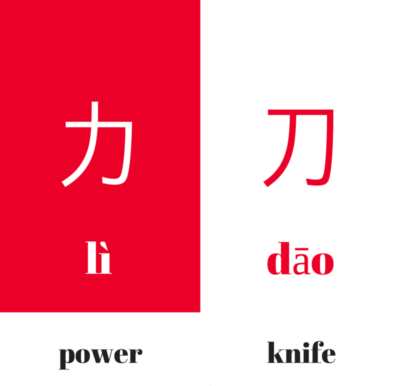
/ (lì/dāo) power/ knife

1-e1466158958266

Difference: The balance of these characters is slightly different, as the  (dāo) character is larger and takes up the whole ‘space’. The  (héng) stroke of the  (lì) character should begin lower, allowing for the downward curving stroke, known as  (piě), to begin above the horizontal stroke.

Examples of  (lì):

努力 (nǔ lì) – to try hard

压力 (yā lì) – pressure

Examples of  (dāo):

刀子 (dāo zi) – knife

剪刀 (jiǎn dāo) – scissors

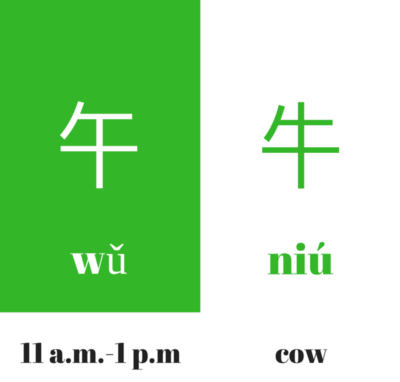
/ (wǔ/ niú) 11 a.m.-1 p.m/ cow

2-e1466158896372

Difference: The tip of the vertical stroke on the  (niú) character, known as  (shù), begins slightly above the first horizontal stroke,  (héng).

 (wǔ) is rarely used on its own, and often found in time phrases like in the following:

Examples of  (wǔ):

下午 (xià wǔ) – afternoon

上午 (shàng wǔ) – morning

Examples of  (niú):

牛肉 (niú ròu) – beef

牛奶 (niú nǎi) – cow’s milk

/ (yǐ/ jǐ) already/ self

3-e1466158756421

Difference: Two of the more difficult characters to distinguish between,  (yǐ) and  (jǐ) are almost identical apart from a tiny extra line in the  (yǐ) character. The  (shù) stroke begins above the second horizontal stroke.

Examples of  (yǐ):

已经 (yǐ jīng) – already

早已 (zǎo yǐ) – a long time ago

Examples of  (jǐ):

自己 zì jǐ – oneself

知己 zhī jǐ – to know oneself

How to Learn Chinese Characters with Mnemonics

With some characters, creating mnemonics can help with distinguishing between similar looking characters. A mnemonic can be a story or pattern of letters that can help you to remember something longer or more complex. A Chinese character mnemonic can help remind you of as many elements of the character as you want, meaning, tone, pronunciation etc.

/ (mǎi / mài) buy / sell

mai-e1466158635503

A simple mnemonic to distinguish between  (mǎi) and  (mài) is that if you ‘sell’  (mài) something you will receive money (maybe ten  (shí) ?). The character  (shí) can be seen added to the top of the  (mǎi) character to make  (mài).

You can apply a mnemonic to any character to remember it. You can visit our Online Dictionary and view existing mnemonics or even post your own ideas.

How to Learn Chinese Characters with Radicals

Radicals are the ‘building blocks’ of Chinese characters. They are most often on the bottom or the left side, and indicate the ‘meaning’ of a character. For example, the character  (kǒu) is also used as a radical and means ‘mouth’. Therefore, the radical  (kǒu) is often found in words that relate to the mouth, such as  (jiào), meaning to shout or  (chī) meaning to eat. In order to learn Chinese characters properly, it’s a good idea to start acclimatizing yourself with some of the basic radicals.

You can learn about some of the more common Radicals here. You can find the radicals for all the characters you learn by checking them in the Written Chinese Dictionary, both online and in themobile app. Just search for the character and you will a ‘Radical Breakdown’ for that character.

For a more comprehensive list of radicals, take a look at the radical feature in our Written Chinese Dictionary app.

Radicals can be one of the best ways to distinguish between Chinese characters, especially as the right hand side of the character often refers to (but not always) the pronunciation of a character.

Let’s look at these characters for example:

线/ (xiàn/qián) line/money

xian-e1466158526941

Both characters contain the same part:  (jiān). It would be very easy to mix up these characters, if you did not pay attention to their specific radicals.

Both characters, 线 (xiàn) and  (qián) , take their pronunciation from  (jiān) that we see on the right hand side. The meaning of the first character 线 (xiàn), is ‘line’ or ‘thread’ and is dictated by the radical on the left hand side, 纟(sī), which represents a bolt of silk. The second character,  (qián), has the radical for ‘gold’ ,钅(jīn) which tells us that the meaning of the character is ‘money’ or ‘coins’.

Here are some other examples of characters that look alike, but can be differentiated by their radicals.

/ (nà/nǎ) that/how

6-e1466158135453

The character  (nǎ) features the  (kǒu) radical, meaning mouth. The  (kǒu) radical, as mentioned above, is often used for characters relating to the mouth. It is also used in some question words including  (ma) and  (nǎ).

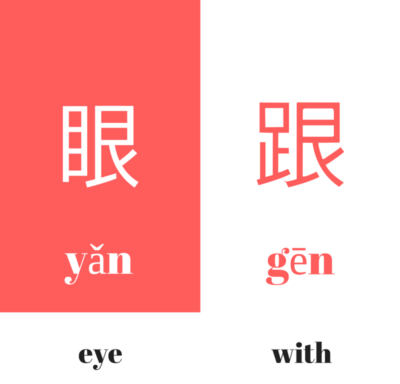
/ (yǎn/gēn) eye/with

7-e1466157665510

The right hand part of the character is 艮 (gèn) and provides the pronunciation for  (yǎn) and (gēn). The radical for the  (yǎn) character is  (mù), meaning eye. The radical found in the (gēn) character is  (zú) or foot. The foot radical is used here because the full meaning of  (gēn) is ‘close behind’ or the ‘heel’ of a foot.

Exercises

If you want to test your character recognition, complete these simple exercises and we’ll post the answers later!

1. Add another stroke to the  (rì) character to make new ones (hint: you can make around 9 characters).

2. Find the ‘wrong’ character in the sentences.

a. 我己经吃过饭了。(wǒ jǐ jīng chī guò fàn le.) I have finished the meal.

b. 下牛去看电影好吗? (xià niú qù kàn diàn yǐng hǎo ma?) How about going to the cinema this afternoon?

c. 妈妈没有告诉我他去哪儿了。(mā ma méi yǒu gào su wǒ tā qù nǎr le) Mom didn’t tell me where she was going.

Welcome to have my face to face lesson on http://www.verbling.com/teachers/dawei  !  🙂

Chinese story: 小男孩和雨伞 The little boy and the umbrella

小男孩儿和雨伞 xiǎo nánhái hé yǔsǎn

yí gè xiǎo nánhái hé jiārén yìqǐ qù wàimian sànbù. hūrán xiàyǔ le, kěshì tāmen zhǐ dài le yì bǎ yǔsǎn.

一个小男孩和家人一起去外面散步. 忽然下雨了, 可是他们只了一把雨伞.

bàba bǎ yǔsǎn gěi māma, māma bǎ yǔsǎn gěi gēge, gēge kànkan dìdi, yòu bǎ yǔsǎn gěi le xiǎo nánhái.

爸爸把雨伞给妈妈,妈妈把雨伞给哥哥, 哥哥看看弟弟, 又把雨伞给了小男孩.

xiǎo nánhái wèn:“ wèishénme bàba bǎ yǔsǎn gěi māma, māma gěi gēge, gēge yòu gěi wǒ ne?”

小男孩问:”为什么爸爸把雨伞给妈妈,妈妈给哥哥,哥哥又给我呢?”

bàba huídá:” yīnwèi wǒ bǐ māma qiángdà, māma bǐ gēge qiángdà, gēge yòu bǐ nǐ qiángdà.”

爸爸回答: ” 因为我比妈妈强大,妈妈比哥哥强大,哥哥又比你强大.”

xiǎo nánhái kànzhe miànqián de xiǎohuār xiǎocǎo, tāmen zài fēngyǔ zhōng yáoyáohuànghuàng de, hǎoxiàng zài shuō: “kuài lái bāngbang wǒmen ba.”

小男孩看着面前的小花儿小草, 它们在风雨中摇摇晃晃的, 好像在说: “快来帮帮我们吧.”

zhèshí xiǎo nánhái bǎ yǔsǎn dǎkāi, qīngqīng de fàng zài le huā cǎo de biānshang, jiù xiànggěi huācǎo dājiàn le yī suǒ línshí de xiǎo fángzi.

这时小男孩儿把雨伞打开,轻轻地放在了花草的边上就像给花草搭建了一所临时的小房子。

Vocabs:

外面 wài mian: outside

散步 sàn bù: take a walk

忽然 hū rán: suddenly

带 dài: to take, to bring

回答 huí dá: to answer

强大 qiáng dà: strong

看着 kàn zhe: to look (at), looking (at)

面前 miàn qián: in front of (him/them)

在风雨中 zài fēng yǔ zhōng: in the rain and wind

摇摇晃晃yáo yáo huàng huàng: shaking, trembling

好像在说 hǎo xiàng zài shuō: as if they are saying

轻轻地 qīng qīng de: gently

放 fàng: to put, to place

边上 biān shang: on the side of… same as 旁边 pángbiān

就像 jiù xiàng: just like

搭建 dā jiàn: to build

临时 lín shí: temporary

The little boy and his umbrella

A little boy went out to have a walk with his family. All of a sudden it started to rain, they had only one umbrella. Dad gave mom the umbrella, and mom gave it to elder brother, but the elder brother didn’t keep it for himself either and gave it to the little boy, his younger brother.

“Why you all passed the umbrella to me? “The little boy asked.

Because I am stronger than your mom, mom is stronger than your brother, that makes you the least strong in the family, so you get the umbrella.” Answered his dad.

The little boy looked at the little flowers with grass in front of them, as if they were crying for help, he then decided to protect the less strong. He gently placed the umbrella next to the delicate flowers. As if he just built a temporary house for those delicate flowers.


Chinese Online Mini Story – Breakup (Beginner to Elementary)

This Learn Chinese short story is written for beginner to elementary level readers. Sentence patterns are simple. You can learn a few new words along your reading. No pressure, take your time. I assume most of my readers are adults or even older teenagers. You really don’t need to start with kids’ stories. I hope my short stories can give you some simple Chinese to read in adulthood.

[simplified Chinese and pinyin]

fēn shŏu


hěn wǎn le。

很晚了。

It was deep in the night.


tā, yīgèrén zuò zhe。

他,一个人坐着。

He was sitting all alone.


zhuō shàng shì kōng jiǔ píngzi。

桌上是空酒瓶子。

There were empty wine bottles on the table.


tā hé tā fēnshǒu yǒu shí gè xiǎoshí le。

他和她分手有十个小时了。

Ten hours had passed since the two of them broke up.


tā zhǐ juéde yè hěn cháng, yě hěn liáng。。。

他只觉得夜很长, 也很凉。。。

He only felt the night was too long, and too cold …


ér tā, zhèng zuò zài huǒchē shàng, xiǎng zhe tāmen

fēnshǒu de xiàwǔ。

而她,正坐在火车上,想着他们分手的下午。

And she, who was riding on a train, was thinking about the afternoon that they broke up.


bù jìde tāmen wèishénme zhēngchǎo。

不记得他们为什么争吵。

She couldn’t remember how the fight started.


kěshì tāmen dōu hăn chū le” fēnshǒu” liǎng gè zì。

可是他们都喊出了分手两个字。

However both of them tossed out the word “breakup”.


jiù zhè yàng, tā men yĭ fēn shŏu jié shù le sān nián de ài qíng。

就这样,他们以分手结束了三年的爱情。

Just like that, they broke up and ended their three years’ relationship.


[simplified Chinese without pinyin]


很晚了。

他,一个人坐着。

桌上是空酒瓶子。

他和她分手有十个小时了。

他只觉得夜很长, 也很凉。。。


而她,正坐在火车上,想着他们分手的下午。

不记得他们为什么争吵。

可是他们都喊出了”分手”两个字。

就这样,他 们 以 分 手 结 束 了 三 年 的爱 情。


[traditional Chinese]

分 手 


很晚了。

他,一個人坐著。

桌上是空酒瓶子。

他和她分手有十個小時了。

他只覺得夜很長, 也很涼。。。


而她,正坐在火車上,想著他們分手的下午。

不記得他們為什麼爭吵。

可是他們都喊出了”分手”兩個字。

就這樣,他 們 以 分 手 結 束 了 叁 年 的 愛 情。


[vocabulary table]

Simplified Chinese Traditional Chinese Mandarin Pinyin English Definition
jiu3 wine
瓶子 瓶子 ping2 zi5 bottle
分手 分手 fen1 shou3 to split up; to break up;
小时 小時 xiao3 shi2 hour
觉得 覺得 jue2 de5 to think; to feel;
ye4 night;
liang2 cold; cool;
争吵 爭吵 zheng1chao3 dispute; strife;
jiu4 just (emphasis);
结束 結束 jie2 shu4 to finish; to end;
爱情 愛情 ai4 qing2 romance; love (romantic)